Tag Archives: Marvel

The Wizeguy: Mind Bender

Every episode of ‘Legion’ Season One made me constantly think “This totally changes what live-action superhero stories can do.” It was so glorious beyond measure. Here was a show that came out swinging with bold unorthodox storytelling that worked so well in getting into the main characters fractured psyche and worldview. Dan Stevens was a phenomenal lead for the program, Aubrey Plaza as an unpredictable enchanting devil mutant was the very definition of fun, the sets and costumes were beautifully idiosyncratic. Eight episodes. They packed it all into eight episodes!

However, let me voice an unpopular opinion.

Am I the only person in the Western Hemisphere who felt the second half of ‘Legion Season One’ (everything in episodes 5-8) was not quite as impeccable as the first? As I was marveling at the (seemingly effortless) narrative juggling of those remarkable first four episodes, at one point I couldn’t help wondering, Can even Noah Hawley maintain such a truly daring storytelling approach for an entire season…? And, for my money, he couldn’t quite.

I have to say my heart sank a little when I realized (“Chapter 6″) that the Legion writers were gonna go ahead and dive right into one of the most popular (read: obvious) tropes of this particular genre: the “Cuckoo Nest” narrative detour (thank you, TV Tropes), beloved by every single writer of every single movie/TV series that comes with the tag “mind-bending.” Sorry, but in the post-Buffy 21st century, this particular move…The now we’ll really mess with the viewer by transplanting the hero/antihero to a supremely creepy location— yes, it’s gonna be a mental ward— and dropping the soon-to-be-dismissed speculation that all the action so far has been a deranged mental fantasy. Again, the 21st-century writer’s-room answer to It-Was-All-A-Dream-Or-Was-It? has become such a cliché. As soon as the Oliver Bird character was introduced/developed (and the campiness of his persona seemed a little odd tone-wise, even for a show that will dare to make Pink Floyd awe-some again), it began to feel to me like maybe a few too many narrative threads were getting dangled, even as I continued to trust Hawley to bring it all together into a seamless whole. Oh, and the finale final-credits twist/teaser for the second season? Didn’t love it. Didn’t really (forgive this) fly for me. Take away the budget/production values/effects, and that kind of Tune-In-Next-Time anti-deus ex machina is pretty much what you’d expect from ‘The Batman’ 1966 television series.

Do not get me wrong. That first half had me truly riveted like nothing since ‘Fargo’ S2. Yes, the cast is uniformly stellar. Yes, Lenny is the supervillain role the one and only Aubrey Plaza was born to play. Yes, I love a seemingly-random-yet-stylistically-appropriate dance sequence as much as the next person. Even as I’m wrapping up this rant, I know damn well I’ll be recording tonight’s premiere (and obsessing over it well into the AM hours). But I do think a mind bender show deserves viewers with a critical mind. Keep it tight, Noah. Ambition is great, until it isn’t.

Legion Season 2 begins airing tonight on FX

-Dagobot


Get at me on twitter: @markdago

Like me on THE Facebook: facebook.com/markdagoraps

Download my latest EP for free: markdago.bandcamp.com


Listen to MY podcast http: http://poppundits.libsyn.com

Anatomy of a Failure: Iron Man 2

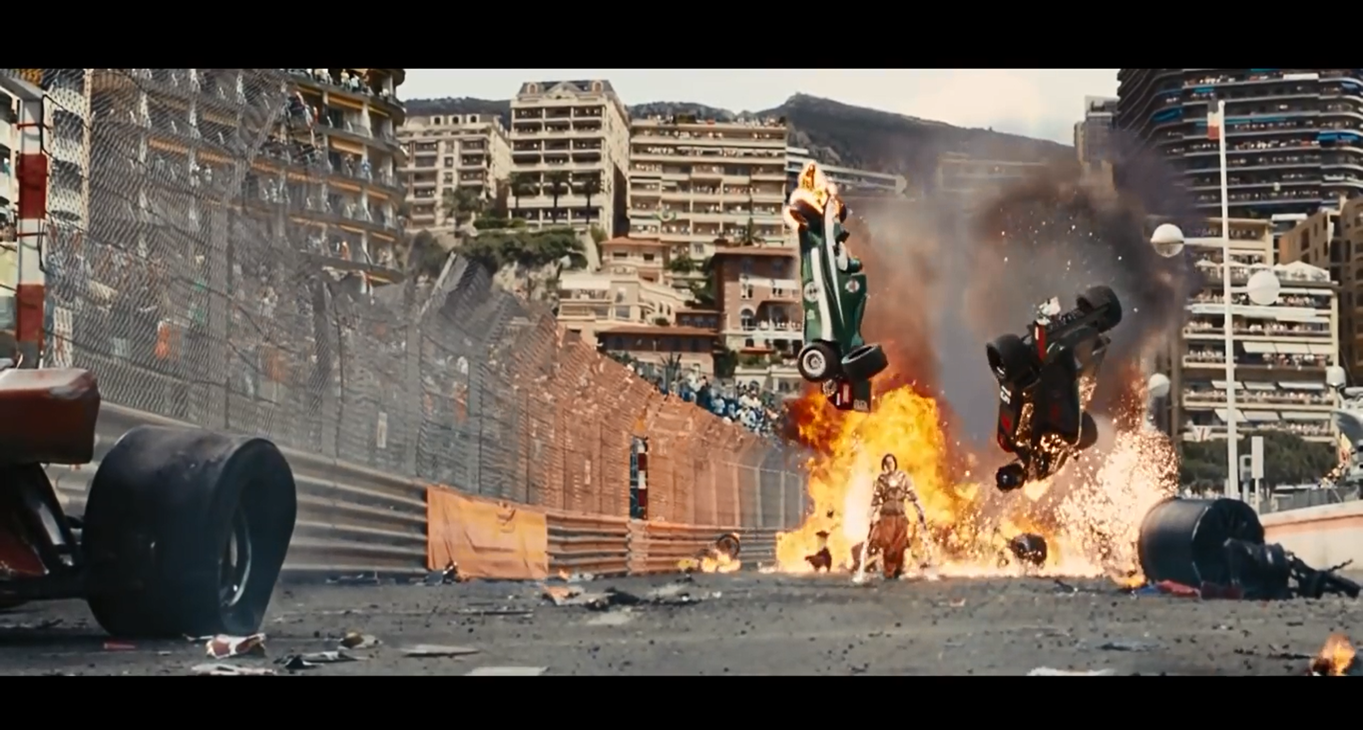
There is a moment early on in Iron Man 2 which serves as a crystallization of exactly why the film, despite all of the things it has going for it, doesn’t work. It is just after Mickey Rourke’s character of Ivan Vanko has busted onto the track of the Monaco Historic Grand Prix and attacked several cars with his electronic whips, including Tony Stark’s own. Stark crashes and emerges from the wreckage, just in time to see it. The cars coming up behind Vanko on the track swerve, desperately trying not to hit him, and crash into one another. The result is a giant, fiery explosion right behind Vanko as he walks towards Stark.

This moment is entirely superfluous in every way, in a manner that is not dissimilar to the work of Michael Bay. The explosion exists simply because someone thought it would be cool to have a shot of Vanko walking away from an explosion in this scene, possibly even mirroring Stark’s own walk-away from an explosion in the first film. But the explosion is an act of entirely passive storytelling. Vanko does not whip one of the oncoming cars, causing the explosion. The cars themselves should not be exploding in the first place, even if they crash, the cars Vanko whipped with untold amounts of energy didn’t explode. If they do explode, with how close they are to Vanko, they should do some damage to him. But perhaps most importantly, the death of these drivers are never addressed again. They did not matter to the story, the explosion did not matter to the story, and no one who is involved with the story was affected by this moment in any way, shape, or form.
Iron Man 2 was released in 2010, just as Marvel Studios was really starting to gear up on the road to The Avengers. The film is often pointed to as a weak spot in Marvel’s ever-expanding catalog and this is essentially the reason why. Many people, Favreau included, said the film did not work because it was simply too busy doing the heavy-lifting of laying the groundwork for the rest of the Marvel Cinematic Universe. But that’s really not true.

Sure, it features the Stark Expo which would later be seen in Captain America: The First Avenger, and it introduces us to Romanoff as Black Widow, who would go on to be featured in countless other Marvel films. Aside from that, we get some S.H.I.E.L.D. references and appearances here and there, a weirdly-placed Captain America’s shield cameo, a namedrop of the Avengers Initiative, and a nod to Phil Coulson’s involvement in New Mexico with Thor’s hammer. But none of these things are what makes Iron Man 2 a weak film. These are integral to the film at their best and simply superfluous at their worst, but none of them take up enough time in the film to ruin it.
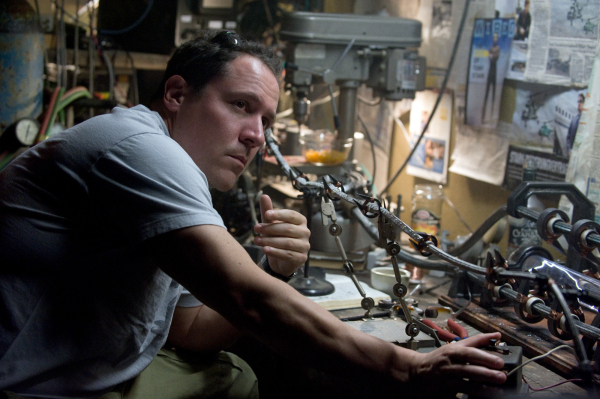
So then, what does derail Iron Man 2? It’s a sequel to a smash success, starring an incredibly likable and talented cast, directed by a visionary and extremely capable director, and featuring some sleek action sequences and imagery, so what went wrong? Well, at its most basic level, the writing. But more so than that, it is the fact that all of Iron Man 2’s storytelling is done passively.

The difference between active and passive storytelling is as simple as the difference between someone saying to you ‘I damaged your car’, instead of, ‘Your car was damaged’. The second sentence is a restating of what happened, without any implication of responsibility. In the world of passive storytelling, things just happen without cause, without reason, and without motivation. And this is exactly the problem that Iron Man 2 runs into again and again.

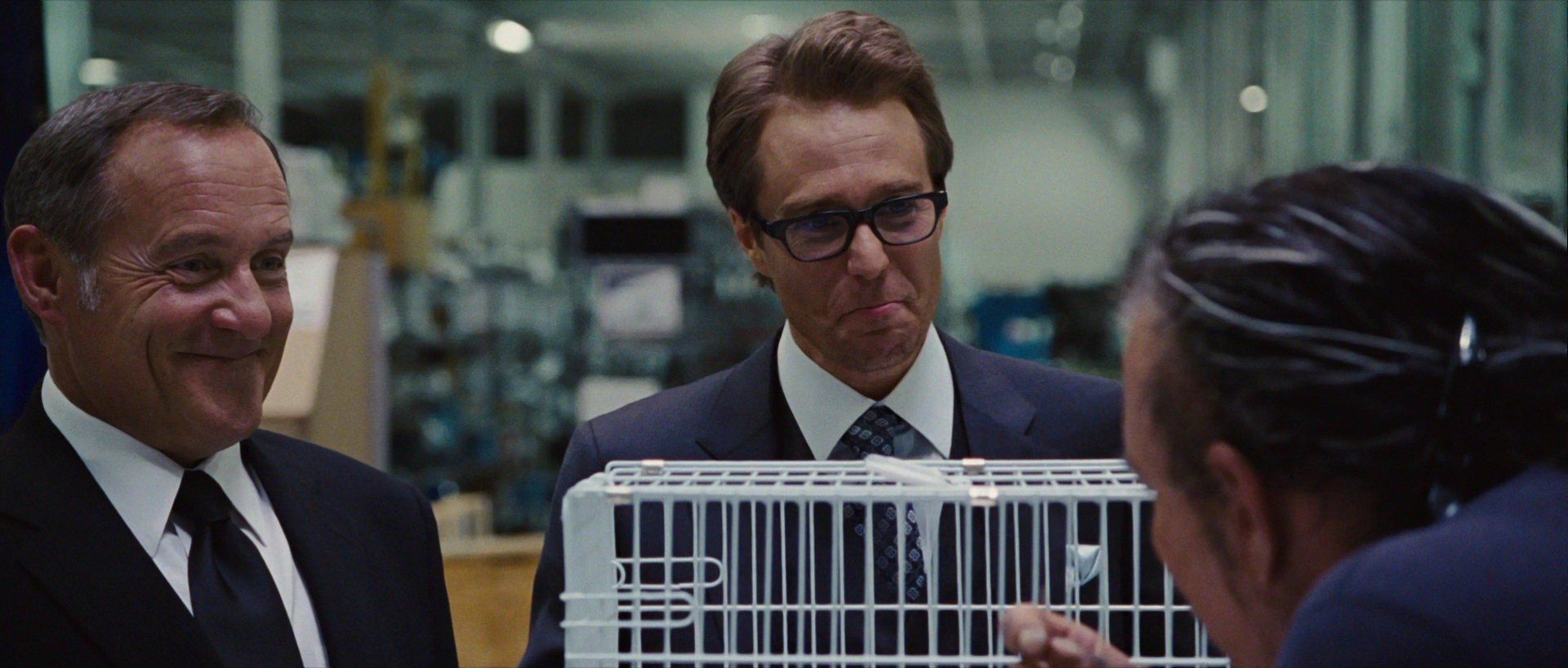
Even looking at the larger picture, the structure of Iron Man 2 itself is entirely passive. Essentially the film spends its run time hopping from one subplot to the next, until its reached feature-length and can just cue up the big third act battle. It starts as a film about Tony and Vanko’s history, before becoming a film about the government trying to ascertain the Iron Man tech from Tony, before becoming a film about Tony’s failings at Stark industries leading to him appointing Pepper as the new CEO, before becoming a film about Tony’s arc reactor slowly killing him and the depressed binge it sends him on, before becoming a film about S.H.I.E.L.D. putting Stark on lock down, before becoming about Justin Hammer, Ivan Vanko, and a bird.
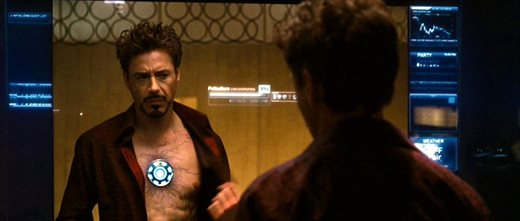
If there is a central storyline here, it is that of Tony having to atone for the sins of his father and come to terms with his own history. Vanko is the son of a man who worked alongside Howard Stark in the creation of the original arc reactor and has now come to claim what he feels is rightfully his. Tony is putting on the Stark Expo, deliberately following in his father’s footsteps. But even this is fumbled, the thread lost over the course of the film. By the time Tony is watching some of Howard’s old reels of footage and Howard turns to Tony and tells him “What is, and always will be, my greatest creation… is you”, it feels completely unearned. The film has done little to nothing to actually explore the relationship between these two men other than to have Tony say that Howard never openly showed him love. Instead of showing us their relationship, at all, the film opts to tell us about it briefly and figures that will be enough.

The script itself cannot commit to actively telling or choosing a story, so instead it tries to tell multiple and loses what should have been its own beating heart in the process.

Even the film’s most essential and supposedly plot-progressing moments are completely undermined by their passive nature. Hammer breaks Vanko out of prison without either one of them ever even forming a semblance of a plan or even having a conversation, it just happens. Rhodey takes an Iron Man suit from Tony to give to the military, and Tony neither stops him nor cares, despite firmly stating up front that he doesn’t want his tech to be weaponized ever again. The cure for Tony’s sickness is literally given to him by his father in a film reel hand-selected for him by S.H.I.E.L.D. Vanko’s goal throughout the entire film is to kill Stark but then he seems perfectly content to just sit around Hammer’s workshop talking about nothing of any importance for the majority of the final two acts simply because the film needs to stall him until its third act finale time.
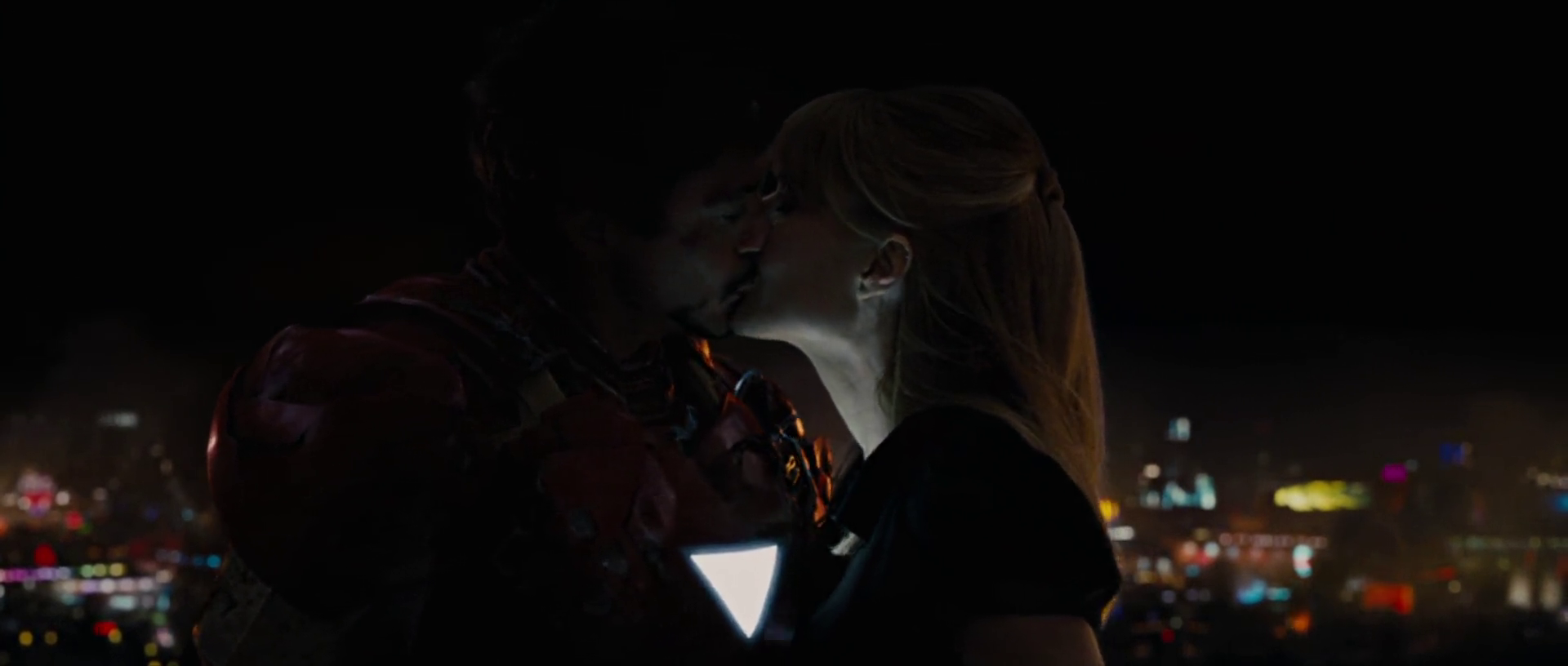
The end of the film even sees Pepper and Tony finally getting together as a romantic couple, but there has been literally zero development between the two of them over the course of the film. Tony makes her CEO to pass off all of his paperwork to her and then buys her strawberries as a gift, which she is allergic to. There is no reason for the two of them to feel romantically close or involved, it just happens. Throughout the film, Tony doesn’t learn any lessons or even really do anything for himself. From the revelation about how to cure his illness, to the victory over Vanko, to his relationship with Pepper, everything is just given to him.

Iron Man 2 is made up of a lot of interesting parts, all of which could and should have added up to something more. But with a script that remains firmly locked into passive storytelling mode for the entirety of its run time, the film comes off as completely limp and ultimately inconsequential.
SLC ‘Black Panther’ Panel: ‘Wakanda Forever’

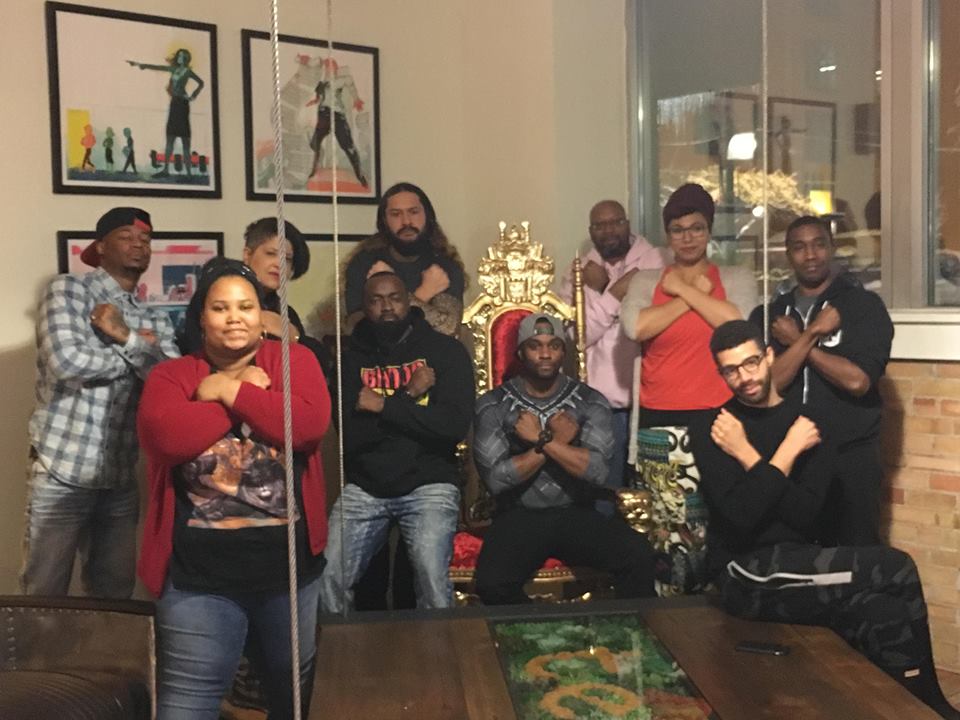
On Monday February 19, a group of prominent people of color in Utah gathered to discuss Marvel’s latest movie, Black Panther. What followed was a funny and insightful discussion breaking down the cultural impact and entertainment value of the film. 

..

Panelists include: Lex Scott, founder of the largest black nationalists organization in the U.S., the United Front party, comedian and actor Jay Whittaker, model, actor, and military veteran Damarr Jones, University of Utah psychology professor Paul White, cosplayer and all around nerd Kiki Furia, host of Cracked Brain Podcast Stephan Watson, performance poet and writer Ashley Finley, bioethics researcher for QTPOC Jordan Blok, and MIke Tuiasoa, Aquaman lookalike and owner of Watchtower Cafe in Salt Lake City.

The discussion was streamed live on our Facebook page but if you weren’t able to catch the stream, want to listen again, or just want to save the audio for posterity, we’ve collected the audio in one shiny package for your convenience. The revolution may be live, but expert commentary is forever. 

‘Black Panther’ Review

BLACK PANTHER (8 out of 10) Directed by Ryan Coogler; Written by Ryan Coogler and Joe Robert Cole; Starring Chadwick Boseman, Lupita Nyong’o, Michael B. Jordan, Danai Gurira, Martin Freeman, Andy Serkis, Letitia Wright, Forest Whitaker, Angela Basset ; Rated PG-13 for prolonged sequences of action violence, and a brief rude gesture; Running time 135 minutes; In wide release February 16, 2018.

This review endeavors to remain as spoiler free as possible.

Black Panther tells the story of a young prince of the fictional country of Wakanda named T’challa (Chadwick Boseman). Due to the events of previous Marvel films, his father has been killed and he will take the throne and assume the mantle of their country’s protector, the Black Panther. The country is in the middle of a struggle for its identity, though. His ex-girlfriend, Nakia (Lupita Nyong’o) feels like Wakanda isn’t doing more to help the rest of the world and perhaps she’s right. But his long lost cousin, Erik Killmonger (Michael B. Jordan) challenges him to the throne in order to offer that Wakandan help to the world in the guise of violent revolution and global domination.

Like any film that revolves around royal ascendency and challenges to a throne, this one can be compared directly to any great Shakespearian drama. Hamlet. Macbeth. These themes permeate through the text in an undeniable way but are freshly crossed with the world of Marvel and James Bond in a way that brings an irrepressible new energy to stories that feel as old as time.

Ryan Coogler brings a solid hand to the writing and direction, bringing a fresh voice to the Marvel universe and proves why we need more diverse takes in the world of superheroes. There’s simply no way a white writer or director could have come to a story like this, and it was a breath of fresh air to watch. It’s going to do incredibly well at the box office and the authentic sense of storytelling that comes from that perspective is exactly why it’s going to.

While it has visual and story touchstones to Star Wars (particularly episodes one and two), James Bond (with T’challa as the Bond character and Martin Freeman’s CIA agent as the Felix Leiter) and other films, the closest film I can imagine to this in recent history is Lucasfilm’s Red Tails. In that film, George Lucas set the stage for a black director and cast to tell the story of the real-life heroes of World War II, the Tuskegee Airmen, and give them the 60s John Wayne war film treatment they deserved, something those heroes had never had before. This does that (and much better, I might add) for the superhero genre and it works preposterously well.

Though I felt the film lagged in just a couple of spots, but that owed to the serial nature of these films. Ideas we’d understood from previous installments felt like a review rather than moving us forward. It’s hard to fault the film for these moments, though, as there will be plenty of people using Black Panther as their jumping on point for the Marvel Universe.

 The actors all bring their best work together and create an ensemble that makes the film enjoyable from start to finish, but there’s no denying that the actor who might have stolen the show was Michael B. Jordan in the role of the villainous Killmonger. The last words he utters in the film are a visceral punch in the gut and it’s predicated on every moment he spent establishing the character. 

While some might see this film as a veiled retread of the first Iron Man film, replacing the Iron Monger with Killmonger, this manages to remain exciting enough to bring tears to the eyes of the audience in at least two different spots. 

Technically, it’s a beautifully shot film and almost makes me cross my fingers for a way to visit it by way of the magic of Disney parks. Thematically, it feels like exactly the sort of hopeful film we need now. It’s an oblique treatise against the anti-collectivist, xenophobic “MAGA” politics of the day, and it makes me feel happy.

Overall, because of the visual aesthetic of the film, the taut pacing (beyond the review portions), emotional work of the actors, engaging window into a perspective I’m not as accustomed to be seeing on screen as I should be, and the fact that film is just a damn good time, I’m giving it an 8 out of 10.

And be sure to stay ALL the way through the credits. 

The Wizeguy: Long Live The King

Did you really thing this was going to be an easy listen? The Black Panther soundtrack is not what you’d expect from a Disney fronted blockbuster. Kendrick Lamar has messages and tells stories. He is a highly innovative artist who has pushed the boundaries of his genre, changing his aesthetic and sonic output with each successive album. He is highly influential in music, fashion, and pop culture. While some might be feeling Kendrick fatigue, He’s everything we need right now. The same goes for the Black Panther film that premieres this week (FINALLY!.) and the Black Panther/Kendrick Lamar pairing makes sense.

So many of these soundtracks are a totally phoned in cash grab. See Suicide Squad or Bright or even Daft Punk’s Tron: Legacy. Even for albums where the aesthetic may not be my thing, you can tell when people are thoughtful about the content and creating a soundscape that makes sense for the project. Kendrick albums are among the few ‘mainstream’ hip hop albums these days that have an overall narrative or theme rather than being a random assortment of songs. The Black Panther film is becoming a cultural touchstone, even before its release. I can’t believe the sheer energy (good and bad) this is generating. I love it nonetheless.

The 14 track LP is filled with cohesive chemistry and composition that is as difficult as the content itself. This ain’t an album full of singles, that’s for sure. That’s a good thing. A curated mix-tape that possesses that strange, uncanny, almost supernatural presence I associate with instant classics – the sort of album that gets picked apart for every detail, dissected over and over and ends up being a rare piece of art that completely lives up to the hype.

While, of course, the album will take multiple listens to fully appreciate, perhaps more, it’s just about impossible for a great album to reveal itself entirely upon its first few listens…sometimes, at least for me, with some instantly classic records I just know. I know, innately – and most of the time after the first or second listen – that I’ll still be talking about that work not only at the end of the year but probably at the end of the decade and beyond. This one did it for me.

So far, the standouts are: Opps, Bloody Waters, X, and King’s Dead. Not trying to pigeonhole the sound of the project. However, Mark Spears a.k.a Sounwave’s production is on some sample flips straight from the record store dollar bins that give you that feeling of recording a demo over the top of some dime-a-dozen pop superstars cassette tape. It is a perpetual state of forward motion with no regard for any rules or norms. Sounwave doesn’t follow trends, he sets them with no real sonic signature. His stage name, adopted from the Transformers figure that disguises itself as a micro-cassette recorder, Mark Spears along with the TDE roster are transforming hip-hop.

Hip hop music is more exciting now than it has been in decades. If you asked me two years ago where the genre would be today, I would never have guessed that we’d be getting a Black Panther soundtrack that doesn’t offer easy answers. To me that makes it a lot more compelling. I can’t wait to see what kind of movie this music inhabits. Just listening through the tracks, you have to wrap your mind around the fact that the soundtrack alone is unlike anything ever put in a superhero movie. Just imagine the story and world that this will flow through. The future is here. Bring it on.

-Dagobot


Get at me on twitter: @markdago

Like me on THE Facebook: facebook.com/markdagoraps

Download my latest EP for free: markdago.bandcamp.com


Listen to MY podcast http: http://poppundits.libsyn.com

Jessica Jones is Back!

It’s been two years since we first met perfectly flawed cinnamon roll Jessica Jones, and the first season managed to tackle a plot without making the heroine’s origin story a focal point. 

Pretty remarkable for a Marvel show, actually.

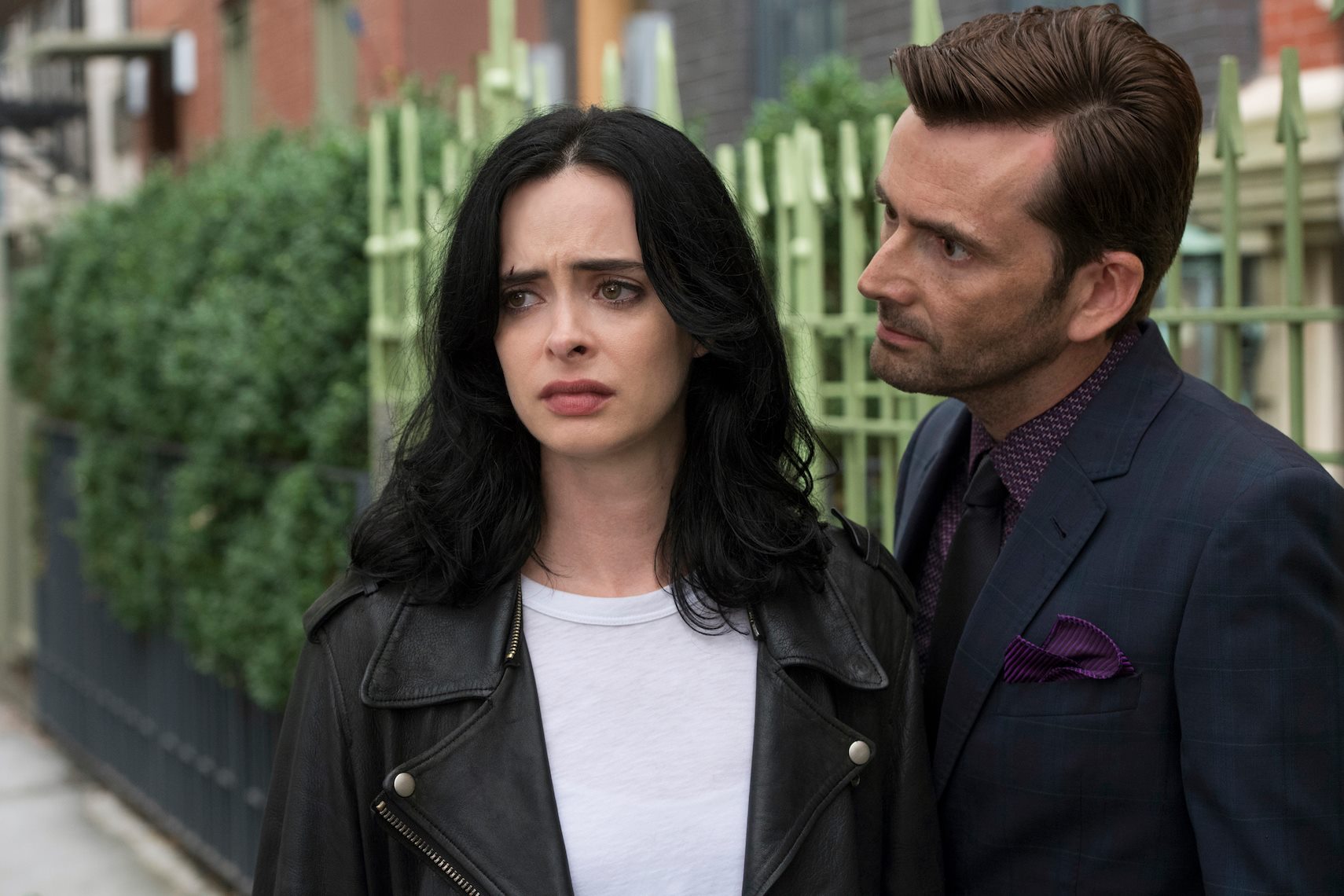
Season two will prove to be a whole new playing field. With the focus on Jessica, we can expect to learn how she got her powers (and how that plot will differ from the original Alias book), what role Trish will play in her life, and how those close to her will deal with the fallout from Purple Man’s reign.

We’ve seen footage and photographs of David Tennant on set–but what could it mean? Personally, I’m putting my money on “he’s a personification of her PTSD preventing her from reaching her full potential.” But that’s just me.

Jessica Jones returns to Netflix on March 8.

Jason Aaron’s The Mighty Thor Review

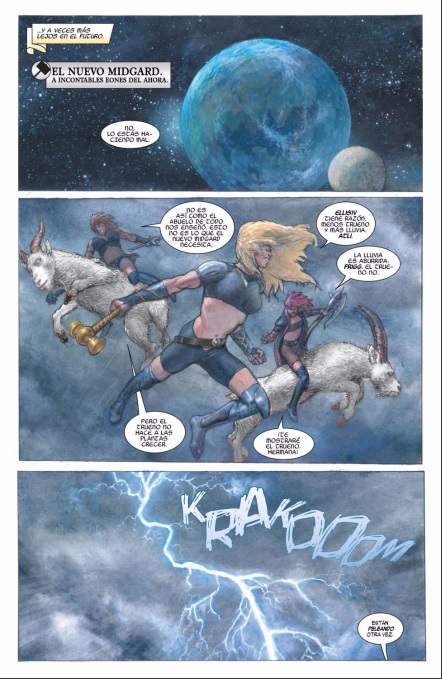
Coming from the land of ice and snow, The Mighty Thor: The Death of Mighty Thor (Marvel), written by Jason Aaron (Southern Bastards, The Other Side, Star Wars), interior and cover art by Russell Dauterman (Cyclops, Nightwing, Supurbia). With Mangog’s arrival, War Thor faces the beast one-on-one. With Mjolnir in his grasp, even the Mighty Thor’s strength will be no match for the hatred of a billion billion beings. And time is running out on Jane Foster, whose cancer has progressively gotten worse.

In The Mighty Thor 700, Aaron, cleverly, regroups and takes note of his engulfing story and the cast of characters interwoven in Malekith’s War of Realms. Aaron takes this opportunity to make Odinson and Karnila the central focus of this double issue. Using Karnila, individually, to consider the concepts of fate. All of the familiar themes of Thor are here, such as the struggle between fathers and sons, will and destiny, and what makes a worthy god. All the while continuing to maintain what makes this series a must read.

There were times I wished Aaron broke down each story into separate shorter accounts for clarity, but once I finished, I was able to appreciate the structure he chose, which once I finished I realized became part of the appeal of the comic. The continuous shifts from one Thor to the next affirms that this war is more significant than any one hero while coming back around to King Thor and the apparent defeat of Gorr. All the cliffhangers and loose ends are correctly are wrapping up amicably.

Such a milestone issue deserves a roster of impressive artists, some of which Aaron has worked with before, and some are new to the series. Series staple, Russell Dauterman is superb as usual as he illustrates Odinson’s epic battle protecting the Norns from Maleketh’s horde. Das Pastoras effectively captures the Scandinavian mythology of the future King Thor. Chris Burnham and Ive Svorcina also display their talent depicting the battle between Gorr the God Butcher and Ego the Living Planet.

In all, every artist that contributed has roots that trace back to Thor’s co-creator, Jack Kirby. While not all of Kirby’s influence is noticeable at first glance, everyone shows the ability to add to this imaginative world. Very solid contributions all around.

Even though Aaron has been writing Thor for five years, he doesn’t show any signs of slowing down. This series is a celebration of Thor’s long legacy past and as well as what’s to come. With Aaron’s writing and a super-group of artists, this massive issue is one of the best of Aaron’s reign.

The Mighty Thor 700-702 are available now, with 703 releasing 1/17/18.

Interview: Ed Piskor – ‘X-Men: Grand Design’

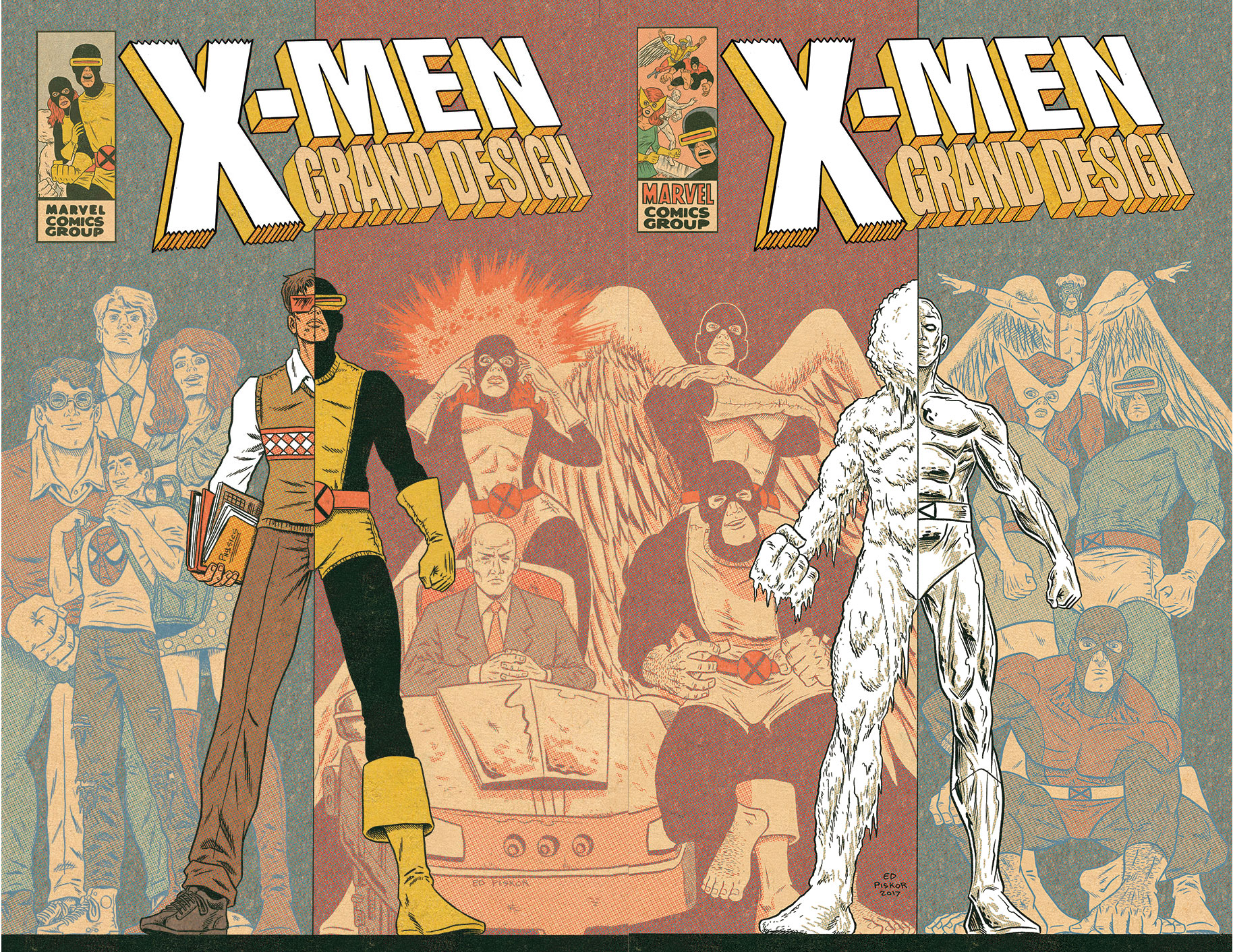
The X-Men franchise can be intimidating to jump into. I mean, with all of that iconic history where does one begin without a guide of some sort or a mainlined wikipedia page and time. Let me introduce you to X-Men: Grand Design by Ed Piskor. Taking inspiration and building off of what came before, Ed has remixed what already exists in his own way.

Think of it in terms of sampling if you will. Flipping a sample means altering it substantially, rather than just inserting it into your song intact. For example, Top Billin’ by Audio Two famously flips the drum break from Impeach the President by the Honey Drippers — the sample is sliced up into its constituent hits and played back out of order, producing a very different rhythm from the original. It is a force-of-nature technique and when it comes to X-Men, Ed is a talented and influential “producer.”

If you don’t already have this title in your hold- PLEASE call your local comic retailer and get it added, ASAP. It is that good. The art is gorgeous and it is filled with an almost unbelievable amount of panaché in the best way possible. We got a chance to speak to Ed recently about the success of X-Men: Grand Design – click the link below and enjoy! 

https://soundcloud.com/poppundits/interview-with-ed-piskor

Grand Design: 1 & 2

‘Avengers: Infinity War’ First Trailer

Holy smokes, artichokes. I knew what to expect and still, I wasn’t prepared. I have chills. The hairs are standing up on my arms and the back of my neck. My spidey-sense is tingling.

This trailer has everything. All your favorite heroes are there, the old and the new. New alliances are forged and old ones restored. It’s only a first trailer and wisdom reminds us not to judge a book by its cover, fast food by it’s commercials, or a movie by it’s trailer. That said, Marvel has made very few missteps heretofore and have earned the benefit of the doubt.

It looks incredible. The rest of the MCU pales in comparison. There’s a bad so big it makes all other bads seem laughable. I’m excited. And I’m scared. Something unspoken in these two-and-a-half minutes implies this one is going to hurt, but in that way that poking a bruise hurts, painful yet so satisfying.

Just watch it. Then watch it again. Ouch. Mmm.

Bendis To Leave Marvel For DC

Brian Michael Bendis is a name almost synonymous with Marvel Comics. If you spend any time looking at the modern revival of the medium, you’ll find Bendis’ fingerprints all over it. The five-time Eisner winner was instrumental in crafting Marvel’s Ultimate Universe and has penned some of the most well-known story arcs of the modern age including Secret War, House of M, and Age of Ultron, just to name a few.

So, news today of Bendis leaving Marvel for their primary competitor, DC, feels like something from the pages of one of his own books. The fabric of reality has ripped, a portal appears, and when everything seals closed again, nothing is the same.

..

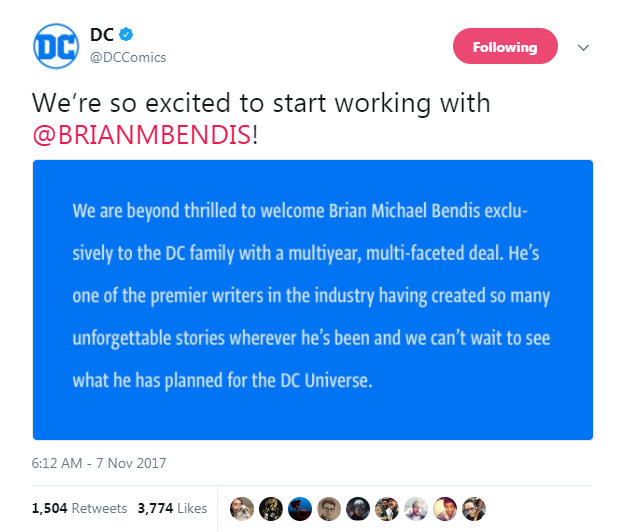
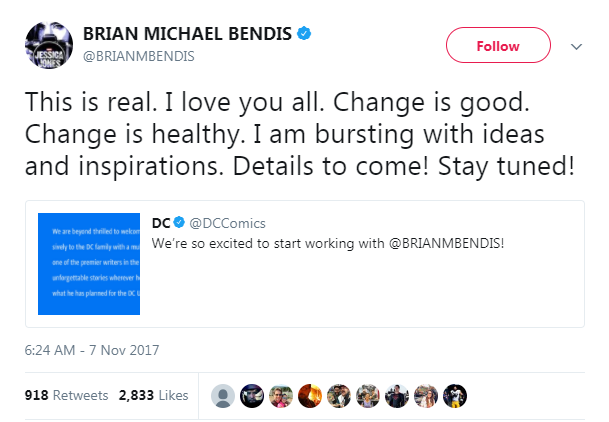
The announcement was made by DC on Twitter, and states not only is Bendis heading for the hallowed Hall of Justice to hang with the likes of the Man of Steel and Dark Knight, but his contract with DC is exclusive, meaning his time at Marvel is coming to an end.

Bendis later retweeted the announcement, confirming it is real and not some nefarious plot by the Anti-Monitor. There’s no official word yet as to when Bendis will leave Marvel for good or what titles he’ll be working at DC. Only time will tell.

..

It’s certain though, no matter what happens, that Bendis has left his mark on the Marvel universe and no world shattering event will change that. We wish him luck in his future endeavors and, like DC, can’t wait to see what he can do with a fresh slate of characters.