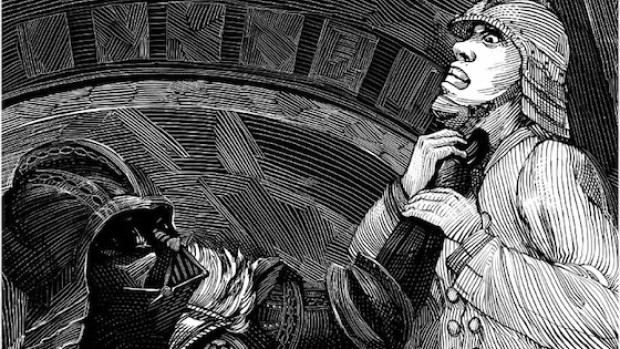
Tag Archives: William Shakespeare’s Star Wars

‘William Shakespeare’s Star Wars: The Jedi Doth Return’ Review

William Shakespeare’s Star Wars: The Jedi Doth Return (9 out of 10) Written by Ian Doescher, illustrated by Nicolas Delort, published by Quirk Books 2014.


May the Bard be with you, Ian Doescher. 

Happily, the bard is with Doescher, as he completes the original Star Wars trilogy with “The Jedi Doth Return.” The first two books in this delightful series, “Verily, a New Hope” and “The Empire Striketh Back” are probably my favorite new Star Wars tie-in products in the last ten years. Doescher takes the scripts from the films and adapts them into Elizabethan verse, mimicking Shakespeare using iambic pentameter and soliloquies and uh…other words I learned in high school but haven’t used since.
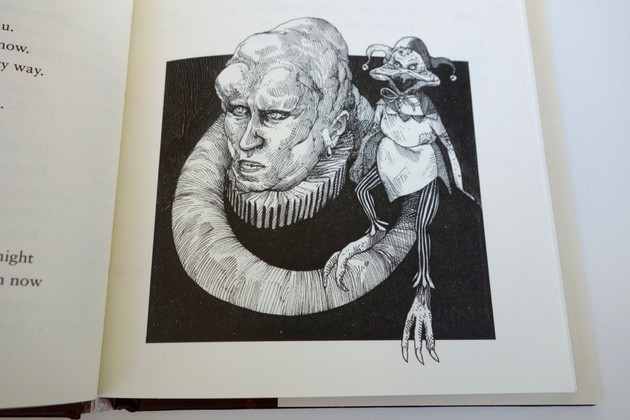
 

Bib Fortuna and Salacious Crumb


“The Jedi Doth Return,” as with “Return of the Jedi,” is something of a letdown for me; the height of the original trilogy is “The Empire Strikes Back,” and from that climax, we only have the loose ends of the saga to wrap. That said, the family dynamics of the Skywalker clan are more Shakespearean than most others in pop culture, and lend themselves well to the format. Darth Vader being (spoilers) Luke’s father, Luke and Leia being (spoilers) brother and sister…they’re twists that the Bard of Avon would have used, and probably did at some point. 


I appreciate the soliloquies most.


As with the other books in this series, I appreciate the soliloquies most. These speeches, spoken as asides during a play, give insight into the deepest thoughts and motivations of characters who may have had only one line–or none–in the films. The Rancor Keeper in Jabba’s Palace, who we see weeping after Luke brings the portcullis (bonus vocab points!) down onto the beast’s head, earns a full-page, speaking about how he raised the rancor from a pup, and how cherished the pet was. I almost teared up reading it. Princess Leia, a character who I think gets short shrift in “Jedi,” is able to speak more her mind and be more involved in this book than she is in the actual script. On Endor, as they’re readying an attack on the Imperial shield generator:


“Such enterprise of pith and moment, yet

Here are we by these furry creatures led.

What unexpected allies! Aye, what strange

But needed friends these noble scamps may prove.

There is a saying back on Alderaan–

Or rather, should I say, there us’d to be

For now no sayings there are heard at all–

‘There should for no one greater welcome be

Than one who is an unexpected guest.’

So do we welcome these small ones unto

Our great and just Rebellion, these who are

Both meek and full of childlike eagerness.”


I love the sentiment, I love the insight into Leia’s character, I love the depth that it brings to the moment. Emperor Palpatine, already deliciously wicked in the film, is made even more despicable here. Admiral Ackbar, most famous now for That One Line, earns more dialogue, and becomes a source of comic relief. It was only after several sentences that I realized Doescher has all of Ackbar’s lines end in words with “ap” at the end. Chap, map, cap…so by the time he gets to That One Line, it was like the culmination of his entire character. Triumphant, beautiful, after all the memes, all the t-shirts, all the jokes that even non-Star Wars fans get–Doescher made that moment shine again.
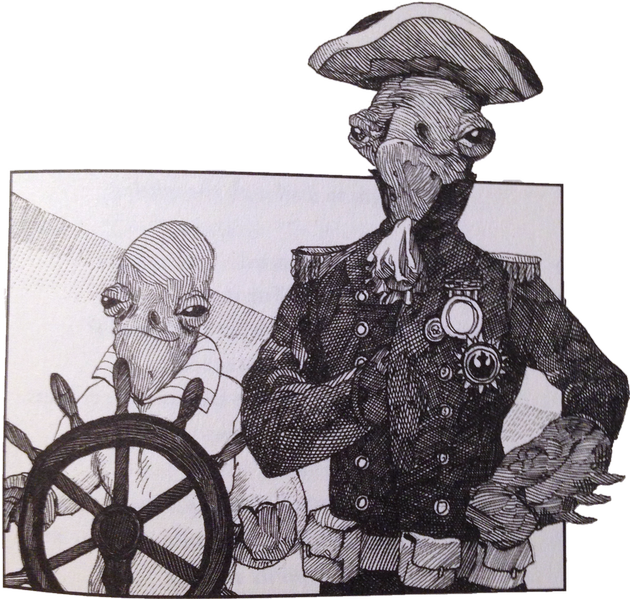
 

Admiral Ackbar


That’s what I love about this entire series. I mean, I love Star Wars as much as the next guy who uses “JediKermit” as part of every online screen name and handle and nickname. And I probably love Shakespeare and Elizabethan English more than many of you. But reading Doescher’s take on my favorite movies has taken a story I know better than my own life story and made me reexamine it. I love him for it. 


May the Force be with you, Ian Doescher.
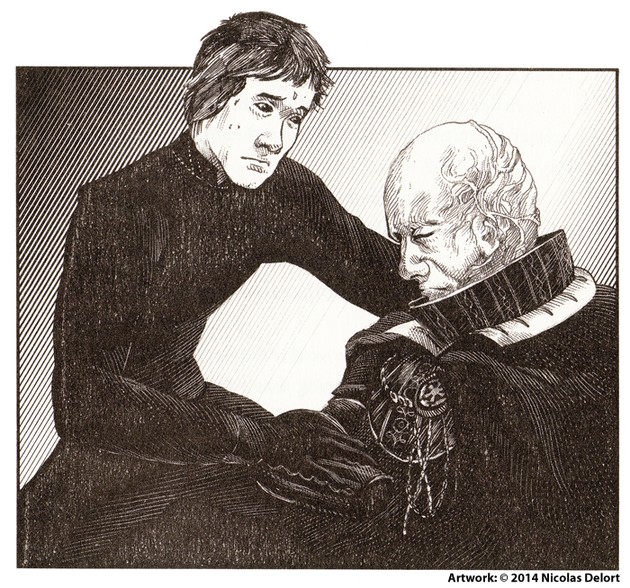
 

Luke and Vader unmasked


William Shakespeare’s Star Wars: Verily, a New Hope

William Shakespeare’s Star Wars: The Empire Striketh Back


‘William Shakespeare’s Star Wars: The Empire Striketh Back’

WILLIAM SHAKESPEARE’S STAR WARS: THE EMPIRE STRIKETH BACK (10 out of 10) Written by Ian Doescher, illustrated by Nicolas Delort, published by Quirk Books 2014.


There are times that someone with the right kind of talent and right kind of vision come upon an idea that’s so brilliant that you have to wonder why someone else didn’t come up with it first. At the same time, you’re so glad that THAT particular person is executing the project that you’re glad that the universe didn’t bring the idea along sooner. 


That’s the case with “William Shakespeare’s Star Wars: The Empire Striketh Back” by Ian Doescher. Obviously the second book in a trilogy (the first was William Shakespeare’s Star Wars: Verily, A New Hope), it’s easily my favorite Star Wars… anything to come out in the last ten years. A big, completely biased part of that is my great love of “The Empire Strikes Back.” When seven year old me saw it in the theaters, it blew my mind. I had watched and re-read the first “Star Wars” movie and picture book adaptation so many times, played with my action figures in our sandbox, and basically lived and breathed Star Wars in the three years between “A New Hope” and “The Empire Strikes Back.” Watching the sequel in the theater, it took all of my thoughts and visions about Star Wars, and blew the doors open on the possibilities of that universe. I wasn’t stuck with playing out a single storyline over and over again–those characters could go to other planets, face new dangers, find new allies and new enemies…and their world was more complex and exciting for it.


By now, I’ve seen “Empire” quite possibly one hundred times. Even though I still love it each time, and usually say that it’s my favorite movie of all time…I pretty much know it forwards and backwards. Every line, every sound effect, every note of John Williams’ beautiful score. I didn’t think there was anything that could deepen my understanding of “Empire.”


I didn’t think anything could deepen my understanding of “Empire”


Then Ian Doescher came along. His “William Shakespeare’s Star Wars” series takes the scripts from the classic trilogy and adapts them to be like William Shakespeare’s plays. That includes Elizabethan language, stage directions, and even iambic pentameter. There are woodcut-style illustrations, showing the characters in tights and ruff collars. There are wooden AT-ATs (Imperial Walkers) being pulled across the stage on little carts by ropes. It would still be a fun idea, even if it weren’t done as well as Doescher does it. But what he does is brilliant.


AT-ATs and Snowtroopers


Some of the pleasure I find in this book is simply in how he translates lines I already know by heart:

The original lines from the movie:

LEIA: “Why you stuck-up…half-witted…scruffy-looking…nerfherder!!”

HAN: “Who’s scruffy-looking?”

And then Doescher’s version:

LEIA: “Thou arrogant half-wit,
Thou oversized child, thou friend of slime,
Thou man of scruffy looks, thou who herd’st nerfs,
Thou fool-born wimpled roughhewn waste of flesh!”

HAN: “What scruffy? Scruffy, how? Whose scruffiness?”

I love that. I love Elizabethan language, whether in Shakespeare or the King James Bible. It’s a beautifully poetic language, and as someone who reads both German and English, I love the connections between the two. Doescher does Elizabethan well. Better than the example above actually…I just like those lines. They seem even more Princess Leia than Princess Leia. 


“thou who herd’st nerfs!”


Some of my favorite parts in his first book are the soliloquies and asides — the first where a character basically gives a speech revealing their truest selves to the reader/audience, and the second where the character will break from the scene and address the audience directly before going back into the action. Doescher does basically what I expected with this, deepening characters who we already know, giving them an inner life that we didn’t know before. The most remarkable cases of this are with Lando Calrissian and Boba Fett, each of whom is more a sketch of a character in the original movie. Doescher gives them both more lines than they had, but also deeper motivations and more insight into what they’re thinking in the complicated world they’re navigating. Why would Lando betray his longtime friend Han Solo? It’s here. And it’s really wonderful. 


Lando Calrissian and Princess Leia


Ian Doescher both surprised and delighted me with some other soliloquies and lines; he gives voice to the Wampa (the ice monster who captures Luke in the beginning of the movie), the aforementioned AT-ATs, and most remarkably, the “Exogorth” — the giant space slug that inhabits an asteroid cave. The Millennium Falcon hides there, then flees after our heroes realize where they’re at. The Exogorth’s last lines:

“Was e’er an exogorth as sad as I?
Was e’er a tragedy as deep as mine?
I shall with weeping crawl back to my cave,
Which shall, sans food, belike become my grave.”


Exogorth


In the author’s notes at the end of the book, Doescher explains some things he did differently with “The Empire Striketh Back,” like reducing the chorus from the first book, instead having characters describe things the audience can’t see offstage. He also explains why he has Yoda break from iambic pentameter. I noticed while I was reading that Yoda was still using his “backwards speech,” but there was something different about the lines. Turns out he was speaking in haiku–an elegant solution to Doescher’s problem of making his language different in a script where everyone is speaking oddly. He also explains that he had Boba Fett speak in prose, and gives examples of Shakespeare doing the same. 


Luke Skywalker, Yoda, and Obi-Wan Kenobi


Honestly, there are things on every page that I could show as examples of how this book delighted me. I typically devour books within a day or two, then move on to the next. I’ve savored “The Empire Striketh Back” over a period of several weeks, because I didn’t want it to end. It’s a brilliant, well-executed mash-up that improves on the Bard. The Bard in this instance is George Lucas, but I think Shakespeare himself would have found beauty in these pages. The final installment in this series was just released, and I’m almost done reading it. “The Jedi Doth Return” is one that I both looked forward to and dreaded, because this is the end of this War among the Stars. 

‘William Shakespeare’s Star Wars: Verily, A New Hope’ by Ian Doescher

WILLIAM SHAKESPEARE’S STAR WARS: VERILY, A NEW HOPE (10 out of 10) Written by Ian Doescher, illustrated by Nicolas Delort, published by Quirk Books 2013.


When I first saw the cover of “William Shakespeare’s Star Wars: Verily, A New Hope” flash across Twitter, I had two thoughts: the first was “This is blasphemy, and it must be stopped!” The second thought: “This must be a work of either genius or madness–either way, I must have it!” Ian Doescher’s adaptation of George Lucas’ original Star Wars screenplay to be in the style of the Bard of Avon has moments of genius, and moments of madness. I will say that for most of the time I was reading it, I had a stupid grin plastered on my face.


either genius or madness


Rewriting one of my favorite movies as a five act Shakespearean play could have fallen completely flat. I love Star Wars, I love Elizabethan English, whether in the form of Shakespeare’s plays or the poetry of the King James Bible, I genuinely love it. I was worried that Doescher’s treatment of the language would be poorly-written, or unnecessarily cluttered. Instead, what he’s done is take George Lucas’ script, translate it into iambic pentameter (really!), and discover more depth and meaning to key scenes and characters than I would have thought possible. I mean, I know Luke Skywalker, Darth Vader, Obi-Wan Kenobi and Princess Leia better than I do my own parents. I know their biographies, their passions, their fears…what could Ian Doescher possibly bring to the dejarik table that I don’t already have? Turns out, a lot. 


Bith cantina musicians


Each major character gets asides and even soliloquys that I really love–some of those are expected, and just flesh out the characters. Some are for comedy’s sake–Han Solo gets most of those. What Harrison Ford may have expressed with a facial expression or body language is written out here as an aside, thrown with a wink or a sneer at an audience that isn’t actually there. This formatting as a play will be a barrier to some readers, even more than the four hundred year old language is, but I love it. Doescher uses stage directions and these asides and soliloquys to add new layers of depth to characters that don’t interfere with, but enhance our heroes and villains. 


The best soliloquy is by Luke Skywalker, after seeing that his aunt and uncle have been killed by stormtroopers on Tatooine. I don’t want to put the whole thing in this review, but here’s a portion:

Adventure have I ask’d for in this life,
And now have I too much of my desire.
My soul within me weeps; my mind, it runs
Unto a thousand thousand varied paths.
My uncle Owen and my aunt Beru,
Have they been cruelly kill’d for what I want?
So shall I never want again if in 
The wanting all I love shall be destroy’d. 
O fie! Thou knave adventure! Evil trick
Of boyhood’s mind that ever should one seek
To have adventure when one hath a home–

I’ll cut Luke off there. On the screen, what we saw was Luke standing near his burned home, the smoking remains of his family. The next scene, he’s back with Ben Kenobi and the droids, and is clearly upset, but pretty much says “saddle up, Imma be a Jedi!” This scene at least gives him a few minutes to mourn his aunt and uncle and their blue milk, and summon the courage to go on to Alderaan. 


gives him a few minutes to mourn his aunt and uncle and their blue milk


The book is richly illustrated by Nicolas Delort, who combines elements of Star Wars and Elizabethan dress in woodcut-inspired black and white drawings. So we have Grand Moff Tarkin in a high collar that accentuates his already gaunt features, and Darth Vader with a medallion seal of the Empire on his chest, and a fur-lined cloak in waves around his armored doublet. Jabba the Hutt sports a feathered Italian cap, and Han Solo wears knee-length breeches. We get pieces of how the sets could be designed and how the plays could be staged, which is another thing that boggled my mind. How would a play based on such special effects-intensive movies even work? I hope someone is thinking about these issues right now. 


Darth Vader choking rebel


“Verily, A New Hope” was published last year, and “The Empire Striketh Back” and “The Jedi Doth Return” both came out in 2014. Both were excellent, and may have even exceeded this first entry in the trilogy. Like Shakespeare himself, Ian Doescher has taken a great idea (if not a new one) and run with it. I won’t say that it’s greater than the sum of its parts, but “William Shakespeare’s Star Wars” has made me consider that galaxy far, far away in a new light. And I’m grateful for it.