Tag Archives: Movies

A Christmas Story, Dirty Harry Headline Library of Congress’ 2012 Film Preservation List

I don’t know about you, but I love lists.

From the first wish list to Santa, I was hooked. Today, it’s fantasy football draft possibilities, best- and worst-of opinions and, well, groceries, but that’s another story entirely.
Which brings me to the 2012 National Film Registry of the Library of Congress’ list of films that will be preserved due to their cultural, historic and artistic achievements.
It is an interesting group of movies, covering a wide range of topics and genres, including the Kodachrome tests from 1922, an 1897 boxing match, a remembrance of Nazi tyranny by a death camp survivor, an up close look at America’s favorite sport and an action flick that spawned one of the great quotes in cinematic history.
And like any list, it’s bound to generate debate. Does The Matrix really deserve to be in the Library of Congress? Does A League of Their Own belong alongside a beloved classic like Breakfast at Tiffany’s?
Well, that’s for fans, film geeks and cinephiles to argue about. The Librarian of Congress, James H. Billington, said the 25 films selected for preservation were not chosen because they are the ‘best American films of all time.’
“Rather,” he said, “(they are) works of enduring importance to American culture.”
As a child of the 1970s, there are three films in particular that jumped out to me – one from each of the ’70s, ’80s and ’90s – as well as a couple of classics that I was exposed to at film school that are certainly noteworthy.
Given the fact my first list was headed to the North Pole, it’s appropriate that A Christmas Story will be preserved. The 1983 film, starring Peter Billingsley, Darren McGavin and Melinda Dillon, was a modest success when it debuted, but thanks to TV, it has become a true holiday classic.
The movie, which bills itself as an All-American tale (ironically, much of it was shot in Canada), tells the story of a boy growing up in the 1940s and dreaming about Santa bringing him a Red Rider BB gun. Every adult he reveals this desire to blows him off with the same line: “You’ll shoot your eye out.” But Ralphie, played by Billingsley, won’t be deterred.
Featuring some of the most priceless quote-worthy narration (my personal favorite being when Ralphie describes his dad’s swearing while trying to fix the family furnace thusly: “In the heat of battle, my father wove a tapestry of obscenities that as far as we know is still hanging in space over Lake Michigan.”), as well as dream sequences that highlight the naïve innocence of childhood fantasy (Ralphie uses his Red Rider BB gun to defend the family homestead), A Christmas Story is funny, clever, silly, endearing and, ultimately, a celebration of family.
Another particularly quote-worthy movie is 1971’s Dirty Harry. Who can claim to be a true cinephile if you aren’t familiar with the soliloquy: “I know what you’re thinking. ‘Did he fire six shots or only five?’ Well, to tell you the truth, in all this excitement I kind of lost track myself. But being as this is a .44 Magnum, the most powerful handgun in the world, and would blow your head clean off, you’ve got to ask yourself one question: Do I feel lucky? Well, do ya, punk?”
Directed by Don Siegel and starring Clint Eastwood as a cop who takes justice into his own hands, Dirty Harry ushered in a decade of films that weren’t afraid to tackle gritty subject matter. From Taxi Driver (1976) and The Deer Hunter (’78) to Apocalypse Now (’79) and Chinatown (’74), Dirty Harry certainly reflected a more cynical view of urban life as drugs and crime ushered in fantasies of vigilantism that resonate to this day. The idea that society had started to put the rights of the accused and criminals ahead of the victim was a key theme in the movie and it has certainly had legs as filmmakers have continued to mine that particular philosophical vein during the ensuing 40 years.
Philosophy is also one of the reasons why 1999’s The Matrix is such an intriguing selection.
What could have been a mindless popcorn movie defined by its eye-popping visual effects (hello, bullet time), The Matrix, instead, explored deeper issues about life, truth and faith in a world where a virtual lie could be more appealing than the cold reality of a grim, devastated world.
Andy and Lana Wachowski (and yes, Congress is officially recognizing Lana rather than Larry) co-wrote and co-directed this Asian-influenced action flick in which The Matrix is a computer program created by machines that harvest humans as power sources. The computer-generated reality the machines created so humans wouldn’t realize the horror of their true circumstance makes for interesting philosophical debate. Heck, one of the best features of The Matrix on DVD is the commentary track featuring philosophers Dr. Cornel West and Ken Wilber debating the meaning of the film and the questions it raises.
Also worthy of mention are some true classics, such as 1961’s Breakfast at Tiffany’s (director Blake Edwards and composer Henry Mancini helped shape and give life to what is arguably Audrey Hepburn’s most beloved character, Holly Golightly); 3:10 to Yuma (the original 1957 western deftly balances the tale of a criminal and a lawman as they await their destinies in the form of a train bound for a prison); 1967’s They Call It Pro Football (the first feature from NFL Films ushered in a new era in sports documentaries, not to mention the iconic voiceover work of John Facenda); and Uncle Tom’s Cabin (the 1914 version marked the first time a black actor, Sam Lucas, starred as the movie’s lead character).
You can find the full list of Congress’ 2012 registry selections online, including a description of each film here.
TRAILER: This Is The End

This redband trailer went up yesterday for the comedy “This Is The End” starring James Franco, Jonah Hill, Seth Rogan, Jay Baruchel, Danny McBride and Criag Robinson all playing themselves after the end of the world. It looks like it’s going to be a funny movie. What do you think after watching this trailer?

REVIEW: It’s Such a Beautiful Day

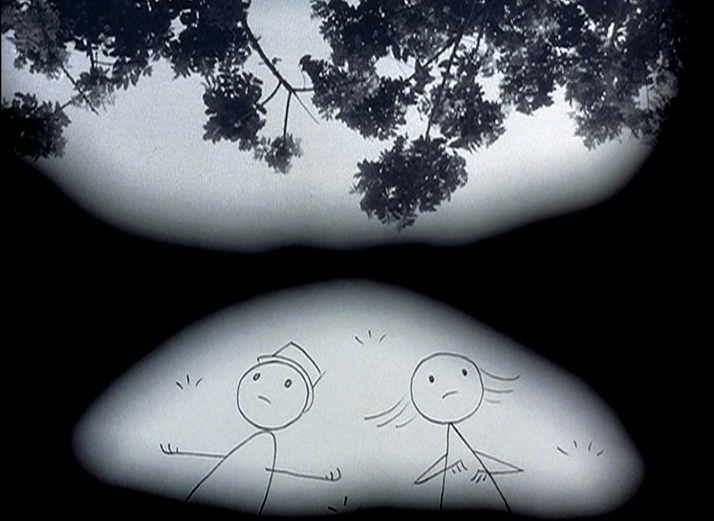
I’ve been a fan of Don Hertzfeldt for years. I first became aware of him when I viewed “Rejected” during my freshman year of college back in 2001. It was one of the funniest things I had ever seen and since then I’ve tried to keep up with his work. Well this morning I got a hold of the feature film version of “It’s Such a Beautiful Day,” this film tells the story of Bill, a normal human being as he lives his life, but some mental complications arise and he’s forced to see his life through a distorted lens. I was unprepared for what this film was going to do to me, I had laughed many times at Hertzfeldt’s cartoons and in the first minute I found myself doing the same thing. I laughed so much that I actually had to stop the movie for a moment to catch my breath and in that moment I wondered if the film could sustain itself for the next 60 minutes. I pushed play and then I was treated to one of the most fantastic journeys I’ve ever been on. I laughed, I cried, I hurt. The movie was beautiful and heart wrenching and I could feel myself in Bill. The movie plays with your emotions in ways you didn’t think possible or had forgotten they could be played with. When the film ended I sat in my chair complacent and in awe of what I just watched. Afterwards I went to my top ten list of 2012 and placed this movie right up on number one. This movie is amazing and I can’t recommend it enough. What made me laugh was I watched this film on what is supposedly the last day on earth, and if it really is the last day on earth then I’ll have been glad to have had this film be my last. So I implore you to get your hands on a copy of this film.

You can purchase this film directly from Don Hertzfeldt’s website:


http://www.bitterfilms.com/

Indiana Jones package at U of Chicago: Mystery Solved!

The mystery of the Lost Ark journal that arrived at the University of Chicago’s admissions office for Indiana Jones has been solved! (more…)

TRAILER: Star Trek: Into Darkness

This film looks darker and more brooding with every trailer. And I’m wondering if there’s an even more sinister background to Benedict Cumberbatch’s character.

This is going to be a great movie, I hope.

Mystery package for Indiana Jones arrives at University of Chicago

“Doctor Jones! I’m so glad you’re back! Your mail is on your desk.” Abner Ravenwood’s diary shows up addressed to Henry Jones, Jr. at the University of Chicago Admissions Office. (more…)

“Fantastic Four” Reboot Has an Official Release Date

The good folks at comingsoon.net have informed us that the Josh Trank  resurrection will arrive in theaters on March 6, 2015. Trank is best known for directing the shockingly cool “Chronicle,” but the film’s screenplay has been written by newcomer Jeremy Slater and the man responsible for the Green Lantern screenplay, Michael Green. Tentative thumbs up? And should we go ahead and start our dream casts? I’m not particularly interested in another origins story and would prefer to see a more mature Fantastic Four made up of a cast that does not consist of empty “blockbuster” names. Some names like Benedict Cumberbatch, John C. Reilly, Reese Witherspoon, Jennifer Lawrence and Clive Owen are floating around the Bot-Shop. What do you think? Who’s best for these iconic roles, and how are your hopes for a successful reboot?


TRAILER: Pacific Rim

I really hope Guillermo Del Toro hits a home run with this one and they let him make anything he wants to after this.

I’m also obligated to say that we were not, in any way, compensated for the use of Big Shiny Robot!s in this trailer.

Pacific Rim hits theatres July 11, 2013.

Should You See The Hobbit in 48fps?

While my review of The Hobbit is still forthcoming, there’s something even larger at play that is the first question out of everyone’s mouth, “What was the 48fps like?”

“Was it any good?”

“Should I bother?”

And I think the answer to those last two questions is a resounding, “Yes.”

Of course, there are undoubtedly a few of you asking, “What in the name of Sauron is 48fps?” In fact, I told a few people how great I thought it looked, people that I thought were plugged into what was going on, and that was their first question. “What’s that?”

Well, without descending into the condescending, here’s the brief overview: movies for the last 80 years have been shot and projected at 24 frames per second. The Hobbit is the first major Hollywood film release that has been shot and in some cases (not all, due to outrage and skepticism) projected in 48 frames per second. What does that mean? It means that all the motion blur you get between shots are gone. It means everything is in a crystal clarity that is breathtaking to behold. It’s the film equivalent of jumping from VHS to Blu-ray. It’s a marked difference in image quality and clarity.

Battles that were once just blur are now rendered in stunning quality, allowing me to drag my eyes to any part of a battle and focus in. Landscapes are incredible. Sets and props are rendered in a detail higher than anything we’ve ever seen, which means there will need to be a new renaissance in those fields of artistry.

I think all the reports are true: when you see The Hobbit, there is a period of adjustment. For me it was between 5 and 10 minutes and it was because I was actively looking for the differences in projection rate. After that, the film became immersive and never once kicked me out of the film again. To that end, it would have been wise of the studio to make sure there was a 20 minute trailer reel or short presentation that showed off 48fps BEFORE the film started so that when The Hobbit started, all the stigma and “getting used to it” were gone.

But it might only be required for the first viewing. I talked to another gentleman in the press (and a sometime Big Shiny Robot, Nexus 9) who was seeing the film for the second time and he found that those issues were simply not present on a second viewing.

Make no mistake: this is a different way at looking at cinema, and for many people (and I would say virtually all of the naysayers) it’s going to be a hard adjustment. We’ve been accustomed for so long as of to what films “look” and “feel” like and this is a step beyond.

I’ve likened it to how jarring it must have seemed to audience used to a jerky, hand-cranked variable 14-24fps frame rate of the silent era to the consistent 24fps paradigm. It was an increase in quality, but must have been awkward during the transition period.

Try these two clips on for size:

The first is from Charlie Chaplin’s masterpiece, The Immigrant.

Compare the look of that to the look and sound of Al Jolson’s (admittedly racist) number in the Jazz Singer just ten years later. The film had to stay synced at a constant frame rate to maintain the sound and must have seemed jarring to an audience used to the jerky nature of silent films to that point.

Now imagine the leap of slightly over a decade later, when the technology grew up even further. Would you have a hard time adjusting to a story told in color? Here’s a scene from Gone With the Wind…

This early color process was extremely difficult and a new technology. They had to film each color spectrum on separate reels of film and combine them in post production to produce a color image. It didn’t look like reality. And with the nature of color dominating mood and theme in the film, set dressers used to black and white had to completely relearn how to learn their craft. Which is why you saw black and white movies winning Best Picture Oscars on a fairly consistent basis through 1960, with Billy Wilder’s masterpiece The Apartment.

The art of storytelling and dressing sets and costume design was more tried and true in Black and White. But color pressed on. It was a tool in the storyteller’s kit and people grew used to it and we moved on.

Another thing to consider is the time at which the movie comes. Watch this clip from Alfred Hitchcock’s Marnie:

It looks like standard Hitchcock fare, yes? You know it was a commercial and critical failure? Not because it was bad, though it was lesser Hitchcock, but because audiences in 1964 were thirsty for movies that looked more realistic and were shot on location. Marnie utilizes many, many bad matte paintings, rear-projections, and mechanical horses and moving backgrounds that would have seemed revolutionary a decade prior. But with movies like James Bond forcing audiences to ask for more, it just didn’t click at the box office. Time has been much better to Marnie, and it’s watched in context with Hitchcock, not the fickle demands of the audience of the day and what they were used to. He stayed too locked in the technology of days gone by and paid a price with the success of the movie.

I think the 48fps phenomenon is exactly like all of these examples. It is a new tool in the toolbox of filmmakers. For those whose story it will enhance, it will do so. But there are naysayers reacting to it in a knee-jerk way, saying it’s just the latest gimmick, but why do we need to think of film as constrained to the limitations of 24fps? Tradition? It doesn’t make sense. That’s like saying Gone With the Wind should have been black and white because color was just a gimmick.

The Hobbit looks stunning. I truly felt immersed in that world watching it in 48fps. I think those that approach it with an open mind and give it a chance will find the same thing. It’s a beautiful film and the 48fps even clears and clarifies the 3D, making it not only more bearable (I’m not typically a 3D fan), it felt more immersive than a film ever has.

Some have been complaining that it looked like Masterpiece Theatre or some other soap-opera like production because it had an odd quality that we associate sometimes with programs like that instead of film. I argue this has everything to do with their misconception of what things should look like, not what they actually look like.

Bottom line is this: The Hobbit looks fantastic in 48fps. I wouldn’t want to see it any other way (though I’m curious to see 48fps without the 3D). It was immersive, detailed, and stunning. I hope to see more films utilize this tool. I wouldn’t be surprised if the new Star Wars films were filmed with this technology and I’d be happy and grateful for it.

Is it different? Yes. Is it unlike anything you’ve seen before? Yes. Does that make it bad? Not in the least. It added a depth to locations and places I’d seen a hundred times in the Lord of the Rings movies and breathed new life into them. Seeing Rivendell literally forced the breath from me it was that awesome. And I say that not as slang, but actually awe-inspiring.

If you’re not sold on 48fps after the first time, give it another go. You’ll definitely see something new.

TRAILER: Zack Snyder’s “Man of Steel”

I will freely admit that I’ve not read many Superman comics. Unless it’s written by Grant Morrison or takes place in a Communist AU. However, Superman movies (and television shows, don’t hate) are my favorite. My absolute without a doubt favorite. Until this year, the ’77 “Superman” movie was my unquestionable choice for Best Comic Movie Ever Made. It’s still in the number one spot, but we’ll see if it stays that way after I’ve had another thirty years to think about “The Avengers.” Anyway – check out the new trailer!

So many people are worried about the choice of Zack Snyder for this movie, but I’m hopeful that his style will compliment a Superman story. I will say that this is the first time I’ve been sold on the casting of Henry Cavill, and I’m very anxious to see Amy Adams’s Lois Lane. Anyone else wildly excited for this movie?

The world can’t end next week, you guys. It just can’t. There are so many movies I want to see next year!