Tag Archives: Marvel

‘Spider-Man: Homecoming’ Trailers

The first trailer for Spider-Man: Homecoming is here and it is everything you want it to be. There’s humor, action and it looks like plenty of Iron Man as well just to make sure everyone knows this is the Spidey movie Marvel is putting their stamp of approval on. It looks like they are combining some of the Miles Morales with the Peter Parker we all know and love. One example is that fans of the comics will recognize Peter’s best friend in the trailer as someone who looks a lot like “Ganke” from the Ultimate Spider-Man comics. The big difference being that in the comics he is Miles’s best friend not Peter’s. More easter eggs and nods to the fans are hidden in the trailer. Enjoy! 

UPDATE: The international trailer has hit the internet as well and has a little bit of different footage. Which trailer did it best?

Spider-Man: Homecoming swings into theaters July 7th, 2017.

‘Doctor Strange’ Review

DOCTOR STRANGE Directed by Scott Derickson; Written by Scott Derrickson and C. Robert Cargill; Starring Benedict Cumberbatch, Tilda SwintonChiwetel Ejiofor, Benedict Wong, Mads Mikkelsen and Rachel McAdams; Running time 115 minutes, Rated PG-13 for action violence and some frightening images; In wide release November 4, 2016.

“Doctor Strange” is the fourteenth entry in the Marvel Cinematic Universe that has has now stretched for nearly a decade. Once again, Marvel has taken a character few outside of geek culture will recognize and given him the big screen treatment.

Stephen Strange (Benedict Cumberbatch) is a brilliant and egotistical neurosurgeon who is world renowned for the near miracles he can perform on the operating table. A near-fatal car crash however leaves him with permanent nerve damage in his hands which means that he can barely write his name let alone perform surgery for the rest of his life. After wasting his fortune on experimental treatments that do nothing to restore his hands, he travels to Nepal to find Kamar-Taj where it is rumored he can find someone to at last heal him. He is taken in by The Ancient One (Tilda Swinton) and her acolytes Wong (Benedict Wong) and Mordo (Chiwetel Ejiofor) who show him that there is more to this world than the book studies he has come to rely on. Opening up his mind to the mysteries of the universe, Stephen Strange studies the forgotten arts and must decide to use his powers to save himself or possibly all of mankind.

There is a lot more to talk about here, but we want to save the events of the movie for everyone to experience for themselves. A few of us here at BSR did get a chance to see it at an advance screening, so we wanted to band together to share our thoughts in a spoiler-free review for everyone to enjoy.

Adam: So I’ll be the first to admit that I had very little knowledge of the character going in. In fact, before doing a little bit of research by reading the graphic novel “The Oath”, most of what I learned had come from the trailers of the movie itself. What the movie accomplishes so well is not only introducing Stephen Strange to a broader and possibly unaware audience but also telling his backstory in such a way that it stays interesting and engaging throughout. Yes, some originitis does slightly set in, but it never lingers in one place too long so that boredom rears its ugly head. Not only does the plot progress quickly, but we are taken to intriguing locales along the way. From New York to Nepal and then the Astral Plane, we whiz along with Strange learning the intricacies of magic and the multiverse along with him. Just as Tony Stark had to broaden his mind by accepting the existence of aliens in “Iron Man 3”, so too does Stephen Strange have to accept that there is more to this world than all the book studies he has committed to memory. There is much that the physical mind cannot comprehend, and we get to experience that first glimpse through the keyhole with him in an extraordinary way.

Andy: Ditto. I knew about Doctor Strange only from his roles in major Marvel crossover events and basic familiarity with his backstory and rogues’ gallery. What is most impressive here is that it stands on its own. You could walk into this movie having read zero comics ever and having seen no other Marvel movie just to see the visuals and the performances by Cumberbatch and Swinton (which is really what you should come for) and walk away immersed in this world. That’s no small feat.

Bryan: Doctor Strange has been a favorite of mine as far back as I can remember and I’ve read many of his comics, but that’s almost irrelevant in trying to judge this film as it stands on its own in the greater Marvel Cinematic Universe. I’m happy to report that it does. As Adam referred to the “Originitis,” I would disagree. This film had to be an origin story because it needed to introduce us to ideas we’ve never before seen in the Marvel Universe. Where “Guardians of the Galaxy” gave us a window into the inner-workings of the universe in the MCU, “Doctor Strange” showed us the multiverse and showing us the rules of how to do that and how our hero will need to navigate it took time. And Stephen Strange’s origin is one of the most fascinating. Thankfully, the filmmakers kept that part of the film cooking and it never once, at least for me, felt tedious.

Adam: I didn’t mean it as a slight against the film by saying it has “originitis.” I’m with you in that you have to have that to explain just how nuanced and layered the character is. Especially since so few will have an understanding of Doctor Strange right out of the gate. This is an origin story that other movies should wisely take heed of and learn from.

Andy: That being said, it felt a little formulaic. We’ve seen this before — largely because Marvel has perfected this formula — but it’s a little bit like complaining that your perfectly-cooked porterhouse steak is “too beefy.” Yup, that’s what you ordered, and it’s what was called for. But it is an origin story and treads over the same ground that Marvel Phase I stories did. At least his story is a little bit … err … strange because that helps keep it moving along.

Bryan: One thing I loved about the film is that it’s rooted in the bizarre, surreal imagery that Steve Ditko brought to the original book. The look of it is completely bonkers and following it with any sort of logic seems impossible. 

Adam: Ditko is present as well as Escher. I can honestly say I have never seen anything like this in any movie that has come before. Sure, many were saying this is Marvel’s “Inception”, but what takes place in that film pales in comparison to the wonders to behold here. Mind boggling is almost an understatement. 

Andy: Comparing this movie to “Inception” or “The Matrix” feels kind of like comparing those films to 1960s sci-fi movies. The visuals are taken to the next level, creating that otherworldly sense that Ditko and other artists have brought to comics. Layered on top of the visuals is the first truly memorable score in a Marvel movie since “The Avengers”, courtesy Michael Giacchino. He incorporates eastern instruments without it ever feeling like a cheesy kung-fu movie. The song that plays over the denouement, appropriately titled “The Master of the Mystic End Credits,” successfully incorporates a flanged electric guitar, sitar, harpsichord, asian-inspired strings, and a 1960’s soul/r&b-inspired electric piano into one of the most original sounding songs in a movie in years.

Bryan: I would never compare a great movie like this to a bad movie like “The Matrix” or a good but overwrought movie like “Inception.” Overall, the film plays it safe to what makes Doctor Strange such an enduring character and Cumberbatch inhabits the role with aplomb. He’s obviously having a good time in the part, even when his character is being awful. That’s part of what makes the movie fun. I didn’t expect a Doctor Strange film to be so “fun,” but this really switched that particular knob past eleven.

Adam: Right? There were so many fun and funny moments that help break up the drama and keep the audience engaged without wearing them out. Cumberbatch is fantastic. Hell, everyone does an amazing job! Tilda Swinton is magnificent as The Ancient One and Mads Mikkelsen is malevolent and downright creepy as the antagonist. Everyone brought their A game.

Andy: I was worried with Cumberbatch that I’d spend the movie watching Benedict Cumberbatch acting! And instead he completely disappears into this role in a way not seen in almost any other Marvel movie. RDJ, Evans, Hemsworth, Pratt command their movies, but there’s a lot of themselves in playing Stark, Rogers, Thor, and Starlord. Here the actor completely disappears and there is no artifice to the performance. And Swinton brings a heart to this film I didn’t think possible in the role of the wise old sensei who trains their pupil. She also delivers a clear, compelling message that is so important for all of us to hear, especially this weekend. I always try to ask of a film, “What is this saying about where we are right now?” Iron Man taught us to own up to our mistakes, Cap to stand up to bullies, and Guardians to “give a shit” about the universe. Doctor Strange gives us a message that is undeniable and, in America at least, a prescient warning about narcissism and arrogance.

Bryan: There’s a particular moment in the climax, the way Strange ends up defeating the big bad guy, that put a smile on my face from ear to ear and is the sort of thing I needed in a Doctor Strange film. This really is one of the comics come to life, and it’s the thing that makes Marvel’s films work. They improve on what made the comic great, rather than try to switch the formula too much.

Adam: Bryan, I’ve come to bargain.

Andy: It was great. And you have a hero who is a doctor who takes his oath to “first, do no harm” seriously — for whom the idea of taking a life is anathema. And he finds a way out, using his intellect, his magic, his willpower rather than just beating people up into submission. It’s the exact palate cleanser we need after “Civil War.”

Bryan: Because of the incredible action sequences, well-thought out characters and situations, how smart the script was, and just how fun it was, this ranks as one of the best of the Marvel films. I’m giving it a solid 9 out of 10. We need more like this, please.

Adam: I can’t think of anything the film could have done differently that would have improved it. The story is wonderful and engaging, the acting top notch and it’s one of the most visually stunning things I’ve ever seen. Marvel has done it again, and I can’t wait to see “Doctor Strange” again and also to see what the company has up their sleeve for future endeavors. 10 out of 10

Andy: As impressed as I am with this and the visuals and the performances, I’ve seen other, (slightly) better films from Marvel. It is an origin story and so suffers from having to spend so long setting the table. Even as well-paced and fun to watch as it is, it can’t match some of its peers like “Winter Soldier”, “Civil War” or “Guardians of the Galaxy”, which managed to be an origin story that never felt like an origin story. But, it is both the most visually stunning AND best acted of any of the Marvel films, as well as a fantastic, original sounding score. And so for that I give it an 8.5 out of 10.

‘Luke Cage’ Season 1 Review

LUKE CAGE (8 out of 10) Created by Cheo Hodari Coker; Based on the comic book ‘Luke Cage’ by Archie Goodwin, George Tuska, Roy Thomas, John Romita Sr.; Starring Mike Colter, Mahershala Ali, Simone Missick, Theo Rossi, Erik LaRay Harvey, Rosario Dawson, Alfre Woodard; Hour-long drama streaming all 13 episodes on Netflix now

 “Luke Cage” is the most authentic character of all of the heroes in the Marvel Netflix Originals so far.

For all of the excitement that mounts as each of Marvel’s Netflix Original series premiere, one would assume that eventually the hype will outweigh the reality. There is a similar feeling among fans and critics when a new Marvel movie is announced. So far, the teams of creatives involved in bringing these beloved comic book characters to life have yet to disappoint. With Marvel’s latest Netflix series, “Luke Cage,” they continue their trend of success but do not again reach the pinnacle that was Marvel’s “Jessica Jones.”

That isn’t to say that the series has many faults, but it does have enough missteps to give us pause and consider that balancing thirteen episodes of high action and drama through the lens of a super-hero is not an easy task. Add in the fact that this series, like “Jessica Jones” before it, continues the proud comic book tradition of being socially relevant to our current cultural events and the job only increases in difficulty.

“Luke Cage” is the most authentic character of all of the heroes in the Marvel Netflix Originals so far. Cage himself, is the most relatable character of the three primary heroes to date. His struggles are fantastical but the world around him is very much the one that many in the minority communities in America live in. The people just want to live their lives but gang violence and police misconduct are daily realities that cannot be escaped. “Luke Cage” bravely tackles issues that can cause political arguments but it does so in a responsible and entertaining way.

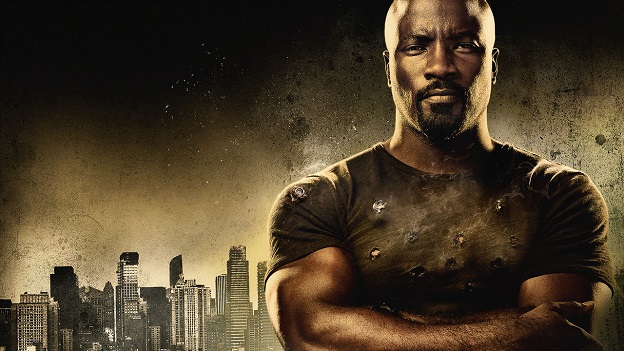
The series knows that its job is entertainment and does not preach, but anyone watching it should easily grasp what the hyperbolic violence is actually commenting on. Luke Cage has to get a new hoodie several times through the 13 episodes because it becomes riddled in bullet holes. Sometimes he’s shot by the criminals trying to profit off of suffering in Harlem and at other times he is shot at by police officers, even while he shields other police officers from the deadly fire of their comrades.

Luke Cage is a reluctant hero in Harlem, as he is hiding from his past, events both mysterious and those revealed in “Jessica Jones.” He is forced into taking action by both his moral compass and his mentor figure in Harlem, the barber and former criminal Henry “Pops” Hunter. Pops runs the neutral area in Harlem, a local barber shop, a place refers to as Switzerland.

Pops is concerned with the location and fate of some of the wayward neighborhood boys he’s tried to turn into upstanding citizens. He knows about Luke’s hidden powers and forces Luke into looking for one of the boys. Pops had previously helped Cage when he first arrived in Harlem, help offered in exchange for a favor down the road, and Pops decides it’s time to collect. It’s at this point that Luke is forced into direct confrontation with the criminal and the police authority elements of Harlem. The catch of course being that he’s unwittingly slept with one of the police officers, Misty Knight, and he’s been dish washing at a club owned by one of Harlem’s most notorious criminals, Cottonmouth. All at once, Luke finds himself the fulcrum around which bends the lever of power in Harlem.

The first half of the series follows Luke on his investigative journey. Some tragedy occurs and Luke decides it’s his responsibility, because he has the power, to take out the criminal organization of Cottonmouth’s. This puts him in the sights of the law enforcement, especially Misty Knight. He carefully minds his identity because of his hidden past (though not carefully enough, get a mask, man). At this point, the show seems to move away from direct social commentary and shift villains in an all too obvious plot.

Cottonmouth is by far, the superior character, but he isn’t the big boss from out of town, Diamondback. Diamondback relies on the show informing us that he’s the big baddie and there isn’t much of the character development that Cottonmouth received for us to really appreciate just how awful Diamond back is. While the remainder of the series plays out, there are scenes where Diamondback is shown to be sadistic and cruel, but only after he’s introduced. It really steals from the urgency felt in the early episodes and slows the series to a crawl through the end. This amounts to one of the few major missteps the show runners make.

The bright note that pulls the show up from the sluggishness is Rosario Dawson’s Night Nurse character Claire Temple. Her chemistry with Luke Cage, played by Mike Colter, is wonderful. It will have new audiences rooting for there to be some dark, hot beverages in both of the character’s futures. Of course, the characters of Claire and Misty have their confrontations as Misty digs in her detective heals against Claire’s more pragmatic sensibilities. Misty certainly wants justice but can’t see past the illusions the villains have put in front of her. Luke Cage just can’t seem to catch a break as he has Harlem’s criminal element framing him for crimes he could have committed, but certainly would not.

The unsung villain in all of this though, has to be the evolution of Mariah Dillard through the helping hands of the truly cringe-worthy (in the best kind of way) personality of Hernan “Shades” Alvarez. Their story is certainly set up for a season 2 of the series, and despite it clashing with the urgency of the first half of the series, Shades and Mariah are utterly detestable villains. Both actors who play those roles are terrific, but I believe the edge for worst villain of the entire series has to go to Shades.

As the series comes to a close there are more references to police officer shootings of unarmed black men in America. The bullet hole ridden hoodies of Luke Cage’s turn from a national embarrassment to a sign of pride for the local Harlem sub-culture. The score plays us through the entire journey in what may be the most well composed score of any modern television series. The song, “Bulletproof Love” by Adrian Younge & Ali Shaheed Muhammad featuring Method Man, is a triumph that caps a score that is just as much of a character as the ones being portrayed by actors on screen. If there is any question in the excellence of this series because of its slight missteps, the score quickly eliminates those.

In the end, we get a wonderful character journey that may be sluggish at times, but is successful in the strength of the acting and score. The story itself isn’t bogged down in the social awareness that it brings to unfamiliar audiences, but the clichés it lets itself fall into do work against it being proclaimed the best superhero series on Netflix. That’s perfectly fine though, because it is still a successful series. Even more of a reason to watch and enjoy “Luke Cage” is because it does a much better job of setting itself up for a second season than the first season of “Jessica Jones” or the last two of “Daredevil” did.

Luke Cage Season 1 Review

The First ‘Iron Fist’ Trailer

The first trailer for Marvel’s upcoming Netflix series “Iron Fist” that hasn’t been all teaser has arrived over the weekend. It’s nice that the New York Comic Con is in the October because we get wonderful pop-culture updates as early trick-or-treats. In the case of the “Iron Fist” trailer, it’s all treats. It’s very clear that the Defenders are on everyone’s minds and Marvel isn’t going to let us forget as the trailer mentions the arrival of the final Defender even before the heroes have created the team itself. 

The rest of the trailer is martial arts delights peppered with villains and Danny Rand’s glowing Iron Fist. I know I’m not the only fan to pump my fist in glee when Danny Rand (played by Finn Jones) appears bare chested and tattooed with Shou-Lao the Dragon. I just hope we get to see a fight with the undying dragon in the mystical realm of K’un L’un. What we definitely get to see is the return of Madame Gao, last seen in “Daredevil”. We were teased with the Steel Serpent emblem of Davos in season 1 of “Daredevil”. Its placement was all over Madame Gao’s illegal activities, so it’s safe to assume fans are in for some martial arts showdowns with Iron Fist’s arch nemesis Davos next Spring. The Trick part of this early Halloween gift from NYCC is that fans now have to be patient in the face of the anticipation this trailer creates. Netflix will premiere the full season of Marvel’s “Iron Fist” March 17, 2017. 

The Music of Netflix’s ‘Luke Cage’ Trailer

The music that drives the next big Marvel Netflix franchise, “Luke Cage”, is a critical part of the street level hero storytelling. In the trailer, Method Man admits to anticipating a “Luke Cage” series since his childhood. The politics of hip-hop and the messages of justice and inequality will be a wonderful soundtrack to a hero who believes in the same but may have a hard time fighting for what he believes in. Music Supervisor Adrian Younge says that each episode was treated like an album. That’s good news for binge viewers because they’re in for a visual and auditory treat. ‘Luke Cage’ premieres in full on Netflix September 30th, 2016. 

New ‘Doctor Strange’ Trailer is Mystical

So many trailers, so little time to watch them again and again. It’s a good thing “Doctor Strange” opens in theaters November 4th of this year, because to wait any longer to see the film would take the patience of a Sorcerer Supreme. As excited as I am though, I can’t be the only one to think Benedict Cumberbatch’s American accent sounds a little bit like Hugh Laurie’s House right?

Every Marvel on Netflix Trailer From SDCC

Get hyped for Luke Cage, Iron Fist, The Defenders and more Jessica Jones and Daredevil. Netflix and Marvel unleashed a deluge of spectacular trailers this weekend at SDCC (San Diego Comic Con). We’ve put them all in one convenient location where you can watch them over and over again. After you’re through watching them for the fifth or sixth time, be sure to let us know which show you’re the most excited for down in the comments below, in a Twitter tweet, or over on our Facebook page.

Marvel’s Luke Cage

Marvel’s Iron Fist

Marvel’s The Defenders

Marvel and Netflix Sizzle Reel


Ta-Nehisi Coates’ ‘Black Panther’ Is Insightful Political Theater

Black Panther panel 1

WRITER: Ta-Nehisi Coates
ARTIST: Brian Stelfreeze
COLOR ARTIST: Laura Martin
LETTERER: VC’s Joe Sabino
DESIGN: Manny Mederos

Ta-Nehisi Coates’ first arc of “Black Panther” is titled “A Nation Under Our Feet”. It takes its title from a Pulitzer-prize winning book by Steven Hahn that examines the world of politics and leadership in the African-American community following the Civil War. In a number of ways, “Black Panther” draws on similar themes; it’s a political tale in the best sense of the word.

Those themes are part of what makes this book unique in the grand spectrum of superhero comics. But “Black Panther” has always been unique. Not only was T’Challa the first black superhero in mainstream comics, but he’s also the ruler of an African kingdom. He’s one of the ten smartest people on the planet, not typical for a world leader to say the least, but Wakanda is not your typical country. It’s at once a utopia, a monarchy, and the most technologically advanced nation in the world. It’s the pinnacle of what we as a society could become. You might be thinking, that sounds too good to be true, and you’d be right. This book is the story of what happens when that world is fractured.

Black Panther panel 2

There are essentially three factions fighting for the future of Wakanda, the first being T’Challa and his government, who have recently lost the trust of the people. A nation that for generations has prided itself on never being conquered, has, in the past year or so, been put through the ringer. A flood brought on by Namor, T’Challa’s rival and monarch of Atlantis. An invasion by Thanos and his Black Order. The death of T’Challa’s confidant, sister, and former ruler, Shuri. All of these things have brought a once mighty kingdom to it’s knees. The Black Panther, the heart and soul of Wakanda, seems rusty and more unsure of himself than ever before.

Not quite opposing T’Challa, but definitely not on the same team, are the “Midnight Angels”, a duo of female vigilantes who have become fugitives because the bureaucracy restricts them from doing what’s right. Not that Black Panther isn’t doing what’s right, but his role as king and inheritor of an ancient legacy has him focused on other battles to be fought. It’s the same argument at the heart of many great conflicts in comics from Batman/Superman to Captain America/Iron Man: do we do what we believe is just, even if it breaks the rules that hold society together?

The third party is a rebellion that is brewing on the border of Wakanda where a splinter group has been gaining followers. Led by a man named Tetu, they are angry that the legacy of their country is being tarnished and no longer see T’Challa fit to run it. On one hand, T’Challa has made some pretty questionable choices in recent times that have resulted in death and destruction. Being one of the smartest people on the planet doesn’t preclude you from letting your emotions control your actions (just ask Tony Stark). On the other hand, Tetu is using a young woman named Zenzi to… not so much brainwash people, but allow their instincts and their rage at T’Challa to take over and control them. She’s really just amplifying what’s already there, but using it to tear the country apart and drive it to a coup d’état.

It’s a complex conflict of different moralities and that’s what makes this book so great. It’s not a metaphorical civil war like what’s brewing between all the big whig superheroes, it’s an actual civil war that is breaking Wakanda, and no matter who wins or who you think is right, there is going to be blood and nobody is going home happy.

I was worried initially as I found the first issue decidedly less compelling than the second. It’s focused on world-building and setting up the brewing conflicts. Honestly, as well written and drawn as it is, I wasn’t sure I needed to add another comic to my pull-list just because it starred a character that I like (a mistake I, and surely many other comic book fans, frequently make, that keeps Marvel and DC from trying anything new). But instead of focusing on soap opera, the second issue doubles down on it’s emphasis on philosophical conflicts. Things really fell into place for me in a moment of debate between Tetu and his former mentor Baba, an argument hinging on the multi-faceted question “What is my remedy against the robber, who so broke into my house?” Tetu asks Baba if he can answer his own question. Baba responds that “the questions are the point” and “what you think is an answer is simply another question.” Which, when I write it, sounds like some Matrix-inspired metaphysical mumbo-jumbo, but in the context of the story does bring up more questions than answers. Is Tetu right to seek vengeance for his perceived injustice? Are the Midnight Angels right to appoint themselves as judge, jury, and executioner? Are T’Challa’s actions the right ones to combat the threats to the kingdom he has sworn to protect? Who is the robber here and whose house is it really? In truth, they are all fighting for Wakanda as each sees fit.

Black Panther panel 3

The fact that “Black Panther” is an intelligent, layered read should be enough to get you to pick up it up, but supporting it is also important because this book is in a unique position to foster diversity in genre entertainment. Everybody knows there is a problem with representation in mainstream comics (hell, everybody knows there is a problem with representation in mainstream media, period), and whether it’s corporate calculation or just plain serendipitous timing, Black Panther is becoming the emissary for black representation in the superhero world. With many proclaiming that he stole the show in “Captain America: Civil War” (quick, someone call the police, a black person stole something) and anticipation for his solo movie at it’s peak, this was the perfect time for a great “Black Panther” run to hit, and BOY HOWDY did it hit. In a world where even the best-selling books struggle to sell 100,000 copies, “Black Panther” hit 300,000 on it’s first print (making it the best-selling comic of 2016), and surely will sell more copies as Marvel does God-knows-how-many more printings.

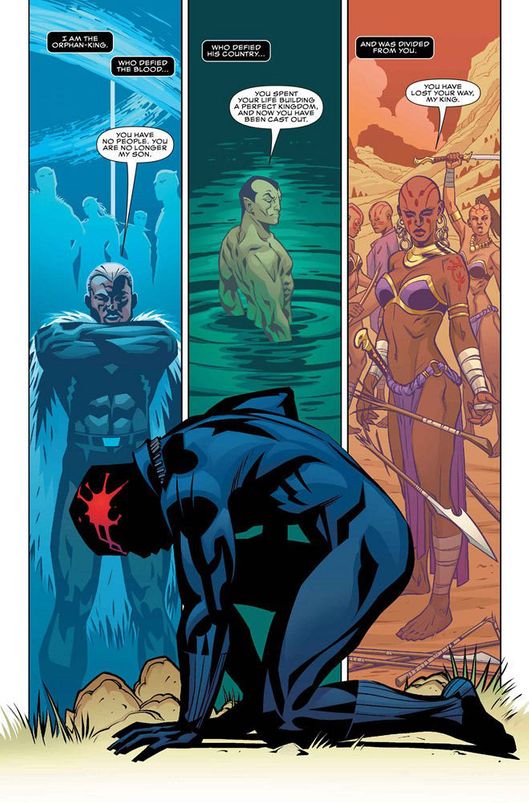
It tackles representation behind the scenes too, uniting two prominent black creators, Brian Stelfreeze, a veteran artist at the top of his game, with Coates, the National Book Award-winning, MacArthur “Genius Grant”-receiving, author/journalist/professor who is in a exceptional place to give the comic book world some perspective about it’s black characters and how they relate to the real world. And kudos to Eisner-award winning colorist Laura Martin for making the characters look like BLACK characters as opposed to the white-washed cinnamon hue that’s been the go to for a caucasian-dominated industry for too long. It’s not just the skin tones; from her choice of deep greens, blues and purples that glow from the page to the pop of the bright red blood that runs down T’Challa’s face, the expert coloring gives this book a singular, vivid look.

Whether it’s The X-Men or Captain America or Spider-Man, Marvel has always been at it’s best when it’s telling a story about the big ideas related to the human experience, and Coates’ “Black Panther” does just that. It’s a story that makes you see the world through different lenses, and in the end, isn’t that something we want from our comic books?

If your favorite comic book retailer has a brain and likes money, they’ll have a copy of “Black Panther” #2 you can pick up right now.

‘X-Men: Apocalypse’ Roundtable Review

X-MEN: APOCALYPSE Directed by Bryan Singer; Written by Simon Kinberg; Starring James McAvoy, Michael Fassbender, Jennifer Lawrence, Nicholas Hoult, Oscar Isaac, Rose Byrne, Evan Peters, Josh Helman, Sophie Turner, Tye Sheridan, Lucas Till, Kodi Smit-McPhee, Ben Hardy, Alexandra Shipp, Lana Condor, Olivia Munn; Rated PG-13 for sequences of violence, action and destruction, brief strong language and some suggestive images; Running time 143 min; In wide release May 27.

After wiping the slate clean and starting afresh after the events of Days of Future Past, it makes sense for Director Bryan Singer to take the younger iterations of our favorite mutants and pit them against one of their greatest foes: the first mutant En Sabah Nur, aka Apocalypse.

So how did they do? Was it more X2 or X3?

Let’s start with a rollcall– state your name, your code name, and your mutant superpower.

I’m Andy Wilson, Citizenbot, and I can compare any other genre movie unfavorably to a film in the Marvel Studios Cinematic Universe.

I’m Adam McDonald, Sithbot, and I don’t get hangovers.

I’m Bryan Young and I’m known around these parts as Swankmotron. (Andy: *whispering* Bryan’s power is Star Wars!)

Andy: This was not a bad movie, but I wasn’t particularly impressed by it. Considering its pedigree and star power, it should be better. Apocalypse is one of those villains that should strike real fear into the hearts of all Marvel comics readers (along with other titans like Thanos, Galactus, or Ultron) but they bungled his introduction and backstory and I never really felt a threat from him. Outside of a few moments I didn’t feel our main characters got a chance to learn and grow (as they had in “First Class” and “Days of Future Past”). All of the character development was saved for the new characters, which isn’t a bad thing except that they’re the side characters. The worst thing is this left me wanting so much more– specifically they set up the next film so well that I couldn’t help feeling like this was the “Age of Ultron” equivalent to setting up the awesomeness that was “Civil War.”

Adam: No, this isn’t a bad movie by any means. There is a lot to enjoy here, and Bryan Singer is giving us a ton of fan service, especially for those of us who are well steeped in the comics as well as the films.

Bryan: I really don’t like the term “fan-service.” It’s loaded in this context and is generally taken as a negative and the things I think you’re referring to as fan-service are the best parts of the movie.

Andy: Is it fan service when The Rolling Stones play “Start Me Up” or “Brown Sugar” instead of something off their new album? That’s kind of how I see this. The key is don’t get caught winking at the audience. And Singer largely avoids that trap, but there are some parts that are. . .  well, a little pandering to the core audience’s tastes.

Adam: This is an extremely talky movie, and I don’t mean that in a bad way. I thought “Civil War” focused a lot on dialogue and discussion, but “Apocalypse” spends the majority of its time letting the characters develop the story through conversation. It was very much like watching the comic of the plot play out in real time, and I actually really liked that. It proves that to be a good superhero movie, we don’t need to spend the whole time watching everyone fight each other. Sure we get some special effects and cool moments with Cerebro and new characters learning how to handle their powers as the come to Xavier’s School for Gifted Youngsters, but the dialogue was done supremely well and got me more intrigued and interested in what was happening. Unfortunately, what was happening barely involved the titular Apocalypse or his Horsemen. Considering the fact that this should be his movie, he’s in it surprisingly little, and he and his coterie only really show up in the last half hour to do battle with the X-Men. I was expecting a lot more, but he spent most of his time fussing with Storm and Archangel’s costumes like it was Fashion Week on Project Runway. He wasn’t even pulling strings or being malevolent in the background until he literally launches his plan at the very end and brings about the necessary final battle. It’s almost as if Singer and company couldn’t figure out what to do with him since he was so powerful.

Andy: Speaking of fashion week, can we talk about Psylocke for a minute? I really like Olivia Munn. And so when you go the route of giving her costume a GODDAM BOOB WINDOW?!?!? It’s hella distracting, in more ways than one. Partially because every time I saw it, I had two thoughts. One of them was “Damn it, it’s 2016– why do we have to talk about how sexist it is to give female characters a boob window?” Especially given Fassbender’s. .  . err. . .  supposed endowment, we should probably at least go for equal treatment, right? Right. #WheresMagnetosPeenWindow?

Adam: Hehe, boob window. Yes, that makes me laugh like a 14 year old, who cares? And yes, we need to see more of Michael “it dented the tub” Fassbender.

Andy: I believe that will be part of his Assassin’s Creed costume. I not, it’s a surefire way to make people go see that instead of Star Wars.

Bryan: For my part, I felt like this was the film Bryan Singer wanted to make in place of X3, and he would have made it with his original cast in the mid-2000s if he’d have had an opportunity. But he didn’t, so this is what we’ve got, undoing the mess Fox created in his absence. It showed me all the things I wanted to see in an X-Men film (even parts that might seem to “meander” or seem unnecessary) and it gave it to me in a package that made more sense than other movies in the genre I’ve seen this year. The failing in this movie is that not every ingredient supports one or both of the film’s main themes. This was the great strength of “Civil War,” every character had something to say about the dueling themes of the film. Psylocke should have had character motivations that played into the overall theme of the film. Angel as well. In fact, the only Horsemen who was fleshed out in this way was Magneto, and he remains one of the most complex characters in the history of comics or comic based films.

Adam: The film also meanders off onto an unnecessary tangent that pads an extra 20-30 minutes on that didn’t really need to be there. Sure, it gave us a few cool moments, and as Bryan and I discussed earlier, more lip service to fans, but it didn’t add anything to an already too long film.

Andy: I know! This movie was long and felt long. However, I’ll defend that portion of the movie only because it’s some of the best stuff in there. This is the problem with “Apocalypse”– the main storyline and characters aren’t as interesting. All of the time they spend developing Jean Grey, Cyclops, Nightcrawler are the best moments of the movie. They were trying to stuff too much in so they can set up the next movie. I really want to see that next movie now. Unfortunately, this one was just kinda meh.

Adam: And lastly, and I swear this is the last of my gripes, because I really did like it, this was full of examples where something worked cool in previous films, so they just took the same ideas and recycled them. The Quicksilver scene in “Days of Future Past” was the highlight of that movie, so of course they added one here and made it bigger and better. Was it fantastic? Of course! And it was also the best moment of this movie as well (well, second best for me, but I can’t say more since it’s a huge spoiler), but it would have been nice seeing them try something new or different.

Andy: That Quicksilver scene. It was as good as anything in “Civil War.” I don’t mind it being recycled and remixed to such great effect. But the only problem is the X-Men are a team. I want to see Quicksilver working with Cyclops and Nightcrawler to set up shots and aerial kicks and so on. I’m a broken record, but I want to see that next movie. And ultimately Quicksilver could’ve had much more of an emotional impact considering his parentage, but that got really muddled and was a wasted opportunity.

Bryan: Again, it’s a case of the character being able to serve multiple purposes, but ends up with only one. It was a bit of a wasted opportunity. This movie is a mess, but an ambitious and fun mess told by people who actually understand how movies ought to work, even if they can’t get all the pieces moving themselves all the time.

Adam: Anyway, I’m not trying to be a downer, because there was a lot here to love. Aside from the dialogue, everyone gives great performances and fully inhabit their characters. McAvoy and Fassbender absolutely own the movie every time they are on screen, but even the newcomers have fun things to do and make us believe they are X-Men. And I absolutely loved Oscar Isaac as Apocalypse. The amazing way they played with the pitch and tone of his voice along with his absolutely godlike powers made him a worthy and malicious foe that the world was right to fear. I just wish we got more of him doing stuff instead of just plotting.

Andy: Well, yes and no. Yes to McAvoy and Fassbender. Yes. Amazing. But Apocalypse’s outfit and makeup looked stupid. Sorry, not sorry. The fact that Oscar Isaac could even act under all of that is testament to his prowess. I just never felt the threat. What were his motivations? He had opportunities to destroy the world multiple times and didn’t. . .  so why? The one thing I truly loved, though, was a final showdown with Charles Xavier. That was worthy.  

Bryan: This movie replicated for me the feelings of reading “X-Men” comics in the ‘80s and ‘90s. Except there were four lines of comics with inter-threaded storylines required to completely understand the stories and the characters, and I was only able to afford three. I had a great time anyway, because I was reading some good comics and I had to fill in the rest myself. As I said before, the film is a bit of a mess, but it doesn’t take away from all the classic moments it gave me, as well as a promise for the future. And the fact that it was entertaining went a long way as well. I’m giving it a 7 out of 10.

Adam: In the end, this does indeed fall prey to the third movie curse as it doesn’t live up to “DoFP” or even “First Class”, but it’s still an incredibly fun time, and I will be more than happy to shell out money to go see it again when it hits theaters. I’m just really hoping that the next film in the series plays out the way it logically should with this ending. 7.5 out of 10.

Andy: Yup. That next movie, tho. I keep going back to my review of “Age of Ultron.” I feel like I’m overly nitpicking a movie I actually enjoyed, but there you go. I think that’s a sign of trouble and a serious case of sequel-itis. X-Men fans should go see this, as should casual fans. But just don’t expect too much of it. 7 out of 10

Why I Love Captain America Part 3

Just five years ago, we’d never seen Chris Evans as Captain America. One the eve of the release of the other Cap films, I came here to pen an ode to my favorite superhero. The first was about Cap’s incorruptible moral compass, focusing on a pivotal moment from my childhood in “X-Men vs. the Avengers”. The second focused on Cap’s value in the MCU and especially why Cap 2: Winter Soldier was one of the best films yet.

And now we have “Captain America 3: Civil War”. This film is near perfect for so many reasons, and all of them have to do with Cap. But before I go into that (including some mild spoilers– I’ll warn you again before we go into them) I want to talk about what’s been happening in the comics. 

In my Part II of my ode to Cap, I talked about how in the aftermath of the death of Steve Rogers, Bucky-as-Cap made the Cap comics better than they had been in years (Winter Soldier as an obvious exception). And in the last year, we’ve seen Steve Rogers de-powered and his best friend Sam Wilson take up the mantle of Captain America. 

One of the best things about Captain America is that anyone can be Cap. Except not really. Not at all, in some ways.

It’s hard to be Captain America, and most of the others who have worn that cowl will agree– they spend most of their time asking “What would Steve Rogers do?” and feeling inadequate in the role. But they manage to find a way and blaze their own unique path, making them heroes as much as Steve was.

It’s great to see others pick up the shield and star spangled costume and try to do what Steve Rogers does. And try is the operative word. One memorable moment of Cap 2: Winter Soldier is Sam Wilson (Anthony Mackie) saying “I do what he does, only slower.” Watching Cap 3: Civil War you see that Bucky’s enhancements have, in many ways, made him even stronger and faster than Cap. 

Enhanced or not, what makes Cap who he is comes not just from powers, but from that moral center and the mission of trying to stand up to bullies and fight for what’s right, no matter the cost. And now extending the mantle of Cap to a black man says something about the expanding diversity of our comics universe. Just like we now how teenage Muslim Kamala Khan as Ms. Marvel and a teenage Dominican Miles Morales as Spider-Man and Jane Foster as Thor, anyone can be one of our heroes. And Captain America is no different. So next. . .  a Latina Captain America? ¡Si, por favor! ¡Andale!

This is what makes Cap so important to me– is since anyone can be Cap, then maybe this middle-aged overweight nerd can be Captain America, too– at least in my own way. And the way to do that is through that moral compass. Ask myself “What would Steve Rogers do?” and try to follow that.

And that brings us to Civil War. 

In case you can’t tell, I’m so #TeamCap that I’ve been vomiting red, white, and blue in excitement for this movie. And the film delivers in every way. 

[Again, minor spoilers hereafter]

The main moral conundrum of Cap 3 centers around the Sokovia Accords– designed to create accountability for The Avengers by placing them under the control of the UN Security Council. 

To understand this argument, let’s talk about philosophy and social theory for a little bit.

A group of social and cultural psychologists have come up with a theory of six “Moral Foundations” that explain the differences in our political ideology. These six values help explain a lot of the differences between liberals and conservatives, populists and fascists, collectivists and individualists, etc. For more information on them, see MoralFoundations.org. But these value sets are: 

1) Care/harm
2) Fairness/cheating
3) Loyalty/betrayal
4) Authority/subversion
5) Sanctity/degradation
6) Liberty/oppression

Let’s talk about the ethical dilemma of the Sokovia Accords along these lines. Both Tony and Steve care and want to reduce harm equally. Hence, Avenging. Both believe equally in fairness. Sanctity doesn’t really come into play here. But where the rubber meets the road are the other three.

At surface level, the argument seems to be about liberty/oppression and authority/subversion. Steve is arguing for liberty. Tony’s arguments for “accountability” are really no more than pleas for government control. This is a complete 180 from Iron Man 2, when he told the Senate that military control of Iron Man would be a form of slavery and/or prostitution. What made Tony change his mind? The final moral dimension: loyalty/betrayal.

Speaking of betrayal, pardon me for a moment while I diverge from talking about Captain America to talk about Iron Man. Because we can’t truly appreciate the quality of Steve’s argument without first understanding Tony’s side.

It is unnatural for Tony Stark — TONY EFFING STARK!!! — to be arguing for someone else to call his shots. His money funds The Avengers. He was the first modern Avenger, until someone found and unfroze Cap. And in “Age of Ultron”, it is the vision inspired by Scarlet Witch’s power that sets everything in motion. This vision had all the Avengers dead, and seeing Cap dead and his shield broken especially took a toll on him. Loyalty– nay, love. Hence his desire to move the Ultron idea forward. And when it caused the terrible damage in Sokovia, he feels that same guilt when he saw militants using Stark-manufactured weapons in the first Iron Man.  

Robert Downey Jr’s acting here is phenomenal. You can see just how difficult it is to ask for compromise, to bend to sign the accords. But he worries about the care/harm dimension and all the collateral damage and friendly fire that Avenging entails. More than that, he understands he has no play to make. His choices were either sign the accords or see them all become fugitives and criminals. 

And when Steve disagrees, he appeals to the one moral dimension most driving him here: loyalty. To Tony, The Avengers is the last family he has. He’s just trying to keep the band together. 

For Cap, loyalty means something else. Specifically, his loyalty to Bucky. His first friend, his only friend when he was that skinny kid in Brooklyn, Steve will stand by him. He fought his way behind enemy lines to save him from Nazis and Hydra, he’ll most certainly make sure he is brought in alive. Cap believes that most fundamental principle of criminal justice: innocent until proven guilty. And he will protect his friend when no one else will.

And this is where the moral dimensions of authority and liberty come into play for Captain America. When asked by Dr. Erskine at the draft board if he wants to go kill some Nazis, he says he doesn’t want to kill anyone– he just doesn’t like bullies. It is a quintessentially American trait to be concerned that government authority can be that bully.

Thomas Jefferson, when facing the Alien and Sedition Acts of the late 1700s– an attempt by his political rivals John Adams and Alexander Hamilton to criminalize dissent against the government (and the Federalist Party)– called out this egregious overreach of government and called on states to refuse to enforce these unconstitutional laws. [Yes Hamilton fans visa a vis Lin Manuel Miranda– your hero played on fears of immigrants and tried to quash dissent and started having journalists arrested for printing mean things about John Adams. Just FYI.]

Cap fought the Nazis, a cautionary tale of how a democratically elected government can shift into a genocidal war machine so quickly that is now so cliched that it has its own internet law (Godwin’s Law). Cap knows we must be ever vigilant, or else we run that risk, too. (Look how quickly we went from Mitt Romney to Donald Drumpf as the standard-bearer of one of our political parties)  

Regardless, the point is that while government’s main duty is to protect the liberty of its citizens, sometimes it becomes the tool that oppresses instead. In fact, that was the major lesson of Cap 2: Winter Soldier and Project Insight, wasn’t it? These are the same governments who thought it preferable to nuke Manhattan than allow the Avengers to fight the Chitauri. And that’s what Cap will fight against. 

Cap believes it is ok to subvert authority in order to protect liberty. Tony does not, and thinks we must respect authority, because “accountability” and “oversight” is better in the long run to protect the people of the world.

The question, though, of whether or not The Avengers need oversight and accountability is the most foundational and fundamental question of government. It is the key question of Plato’s Republic. Quis custodiet ipsos custodes? Who will guard the Guardians themselves? Or, to bring it back to comics: Who Watches the Watchmen?

In Plato’s Republic, Socrates and Plato engage in a thought experiment to try to define what “justice” is. To get at the definition of justice, they “build” a city that is “just” and explain why it embodies justice. Their city ends up being ruled by a class of “Guardians” also known as Philosopher Kings. They spend equal time exercising their bodies and their minds so they may be protectors in word and deed. They are also penniless, so they are not tempted by the corrupting influence of wealth, that they would steer government rather from the protection of justice to the service of commerce and making the ruling class more rich. 

So, in Plato’s Republic, they come to the question– who will watch over the Guardians? Quis custodiet ipsos custodes? The answer they come to is that the Guardians have the capacity to guard themselves. Having been educated in philosophy and other learning, they posses all they need to keep from being corrupted. 

Steve Rogers is the Socratic ideal of a Philosopher King.

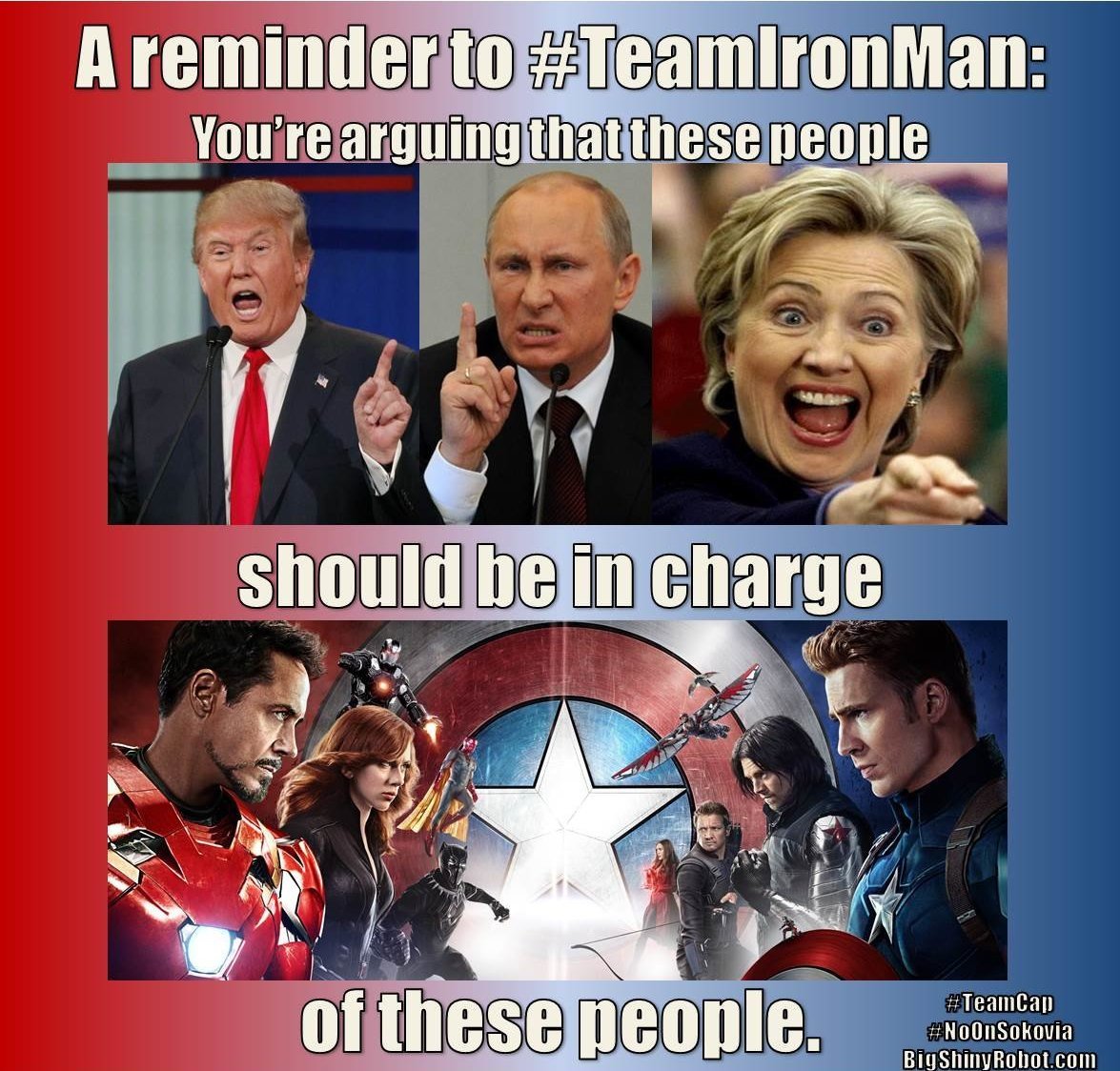
So when the issue comes up of the Sokovia Accords, Steve’s answer is that “The best hands are still our own.” In that, he is 100% correct. Because, to put it very simply:
Reminder to Team Iron Man

And Cap is right. The best Guardians against a Guardian going bad are the Guardians themselves. Besides Steve Rogers, no one else represents the totality of the Socratic ideal of a philosopher king better than T’Challa, The Black Panther. 

And T’Challa does his damndest to put Cap in check. Of course, it’s worth pointing out that the information T’Challa, Tony, and the rest of Team Iron Man are going off of is incomplete and in many ways false. They were set up. He was vindicated on Bucky’s innocence.

And then we have what is at stake in the final battle of Civil War. MAJOR SPOILER AHEAD. DO NOT READ FURTHER IF YOU HAVEN’T SEEN THE FILM. 

“I know we’re not perfect, but the safest hands are still our own.”

Cap isn’t perfect. And in keeping what he knew about the death of Tony’s parents from him in order to protect Bucky amounts to a major betrayal. He messed up. He compartmentalized information just as well as Nick Fury ever did, betraying not only his friend Tony Stark, but the memory of his friend Howard Stark, and his own most personal ideals of honesty.

Unfortunately, he also made the right call. It’s obvious Tony couldn’t handle that information, as evidenced by his reaction to it. He would lash out at Bucky in grief the same way T’Challa did. It’s only human nature.

Again, going back to classic Greek philosophy and Aristotle’s Nicomachean Ethics, you are not morally responsible for actions where you had no choice. James Buchanan “Bucky” Barnes is innocent of these crimes. He did not murder the Starks. His government handlers did. 

While Cap can compartmentalize that information, it’s still a betrayal, and not one that we should gloss over. Cap’s amazing moral compass falters. But that doesn’t mean he’s wrong on the larger point. 

I’d rather have Steve Rogers be wrong one time out of 100 than have Vladimir Putin anywhere near the command structure of The Avengers. Hell, I’d prefer Tony Stark’s faltering moral compass being wrong one time out of 50 than that. Team Iron Man was full of mistakes. Vision got distracted and ended up almost killing Rhodey. But I’d still prefer them to the military who decided it was a good idea to turn Emil Blonsky into The Abomination, try to nuke Manhattan, and launch three Insight helicarriers with the ability to kill millions from the air pre-emptively.

“I know we’re not perfect, but the safest hands are still our own.”

Accountability can take many forms. And being accountable to oneself, one’s friends, one’s colleagues, to a higher purpose and goal, is far more effective than letting the tendrils of the military-industrial complex anywhere near The Avengers.

Nuff ‘said.

To hear me make this case (and some counterarguments by my co-hosts) check out this week’s edition of the Bored as Hell movie review podcast and watch for a spoiler-filled throwdown coming soon.

For more deep thoughts on this subject, please check out Dagobot’s excellent two-parter The High Cost of Avenging, Part One: Tony Stark, Part Two: Steve Rogers.