Tag Archives: Lord of the Rings

‘Tolkien’ Review

TOLKIEN 5 out of 10; Directed by Dome Karukoski; Written by David Gleeson and Stephen Beresford; Starring Nicholas Hoult, Lily Collins, Colm Meany, and Derek Jacobi; Rated PG-13 for some sequences of war violence; Running time 111 minutes; In wide release May 10.

It’s not hyperbole to say that The Lord of the Rings is one of the best and most influential books of the 20th Century. Bits and pieces of the world that sprang to life from the imagination of J. R. R. Tolkien can be seen in almost every fantasy project since and even in standard fiction or sci-fi. And while most people are familiar with Frodo, Gandalf and the One Ring, fewer are probably aware of the story of the man himself and what took place in his life that inspired him to write his epic. Tolkien attempts to fill in the gaps of what we may not have known, and while it is decently well made, it doesn’t quite hold the audience’s interest from beginning to end.

Those hoping this is the story about how The Lord of the Rings was written are going to be letdown as this is about as straightforward as a biopic gets. Starting with the frontlines of WWI, we flashback to him and his brother losing their mother and being placed in the care of a kindly society woman in London. With the help of the church, Tolkien is placed in King Edward’s, a prestigious secondary school where he is at first the outcast before forming a lifelong bond (a fellowship, if you will) with a small group of classmates. They continue on together to Oxford where Tolkien (Nicholas Hoult) loses his scholarship due to some drunken shenanigans only to regain it when his mastery and creation of language impresses a tenured professor. The specter of WWI looms large, however, and the young men are soon thrust into hell itself, and only two survive the horrors of the frontlines. Scarred from his experiences, he manages to live on and create a happy life with his wife Edith (Lily Collins) and their children before deciding to put his language skills to use and create a story that we now know as The Hobbit.
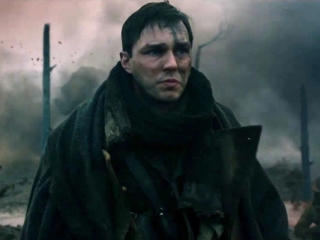
Tolkien war

Tolkien is a film that is definitely less than the sum of its parts. Considering all that the man went through, this biography feels hollow and cold. And what’s even more frustrating is that everything around it is genuinely good. Hoult and Collins are fantastic in their roles as are his classmates, and the cinematography of the war scenes is compelling and chilling. The fever dream that plays out before his eyes watching fellow soldiers being cut down by ringwraiths and orcs instead of bullets and grenades is pure beauty to behold and obviously where a lot of the budget was spent. But it doesn’t make up for the fact that none of it aside from those moments are that interesting which is an absolute shame, because this is about the man that changed the face of literature. It’s just a wasted opportunity that means people will walk out shrugging wondering why it was worth the fuss to begin with.

This is probably coming across harsher than intended, because it’s not a bad film, but it is almost excruciating to see the missed potential of what Tolkien could and should have been. Learning that The Lord of the Rings was inspired by PTSD and what played out in his eyes during the War are the best parts, and those shining moments make the rest of it seem that much dull by comparison. Even hardcore Tolkien fans such as myself are going to be hard-pressed to enjoy it, and ones barely familiar with him and his life might as well sit this one out. But in all honesty, everyone should just set aside 50 hours and rewatch the extended cuts of the movie trilogy. It’s more interesting and doesn’t feel as drawn out.

 5 out of 10
Dragon Con Interview: Craig Parker

Craig Parker is charming and funny, but he’s generally better known for portraying baddies onscreen. He’s probably best known as Haldir from Lord of the Rings, Darken Rahl in Legend of the Seeker, and Lord Narcisse on Reign

He took reporters’ questions at Dragon Con, so we first wanted to know what is he working on next? 

He’s about to go back to Agents of S.H.I.E.L.D, and he gets to be “a blue guy.  Like a smurf. From space. A space smurf.” He portrayed the Kree Taryan in a couple of episodes at the end of last season. And just released information reveals he may appear as a villain on the reboot of Charmed. 

But back to Lord of the Rings. Haldir is quite a fan favorite. What endears him to the fans?

“Peter Jackson, the director, wanted to have a sacrifice. Of nobility sacrificing themselves, and came up with the idea of Haldir dying. And while it is in addition to the story, they read the books hundreds of times, they knew it inside out, and they knew the world . . . To die with Howard Shore’s music playing behind you always helps and to die in Viggo Mortensen’s arms always helps so I think maybe was just jealousy.”

He adds that “It is about the elves not caring about humanity, about being above all that but then making the choice to come back to the alliance. And consequently that leads to sacrifice not just [Haldir]. But also the countless other elves, countless other immortals who laid down their immortal lives.”

You’ve had a lot of success on HBO, Starz, Netflix. How has that affected the industry since not everything’s coming from mainstream Hollywood? And as an actor how has that affected your career?

Craig explains that there used to be only one channel in New Zealand. Then 2, and then more. The first time he worked outside of those channels was Starz when he appeared as Claudius Glaber in Spartacus.

“It was stuff we would never be allowed to do ABC. And it wasn’t. You know, I’m not saying we want to get naked [though they do get naked in Spartacus. A lot] … part of that is you can have characters that are messier and more human and more visceral.

The great thing for me is more interesting television. Television is much more interesting than films nowadays. You can take a 6 hour story . . . And you can take risks and you can create characters and stories that aren’t ‘and then we solved the crime and everyone’s happy, and we did it again, and again and so on.’ It’s exciting times.”

He uses the example of Mad Men, and how it wouldn’t have survived on network television, but the brand grew and then people purchased subscriptions to watch it. We’ve now seen it with other shows, like the success of Game of Thrones.

How much did he know about the real-life background of the character he portrayed on Spartacus?

Claudius Glaber, “in history, he’s got about 3 mentions. We know he commanded the first army that was sent to bring Spartacus’ rebellion to and end. And then he got killed And so that’s pretty much what I had.”

He went on to talk about how the creative team put such intense research into the project, and though they took liberties with “costumes and things,” there was a system in place. The politics of that era were focused on sex, strength, money, or lineage. “And the same today, but it was so much more life and death … And to play in that world as an actor is amazing because you you can take things to extremes … you don’t have to make people like you. You can just be disgusting and every day you get to go to work, and oh we get to crucify someone. Cutting someone’s throat killing someone. It’s very good therapy to go and get that stuff out.”

So are you just drawn to villainous roles?

“I think the bad guy’s always more interesting than the hero to play. Because heroes are limited by what he or she may do because they have to be heroic at all times., I think in shows that are more subtle, more human, I’m fascinated by people who are broken, people who are damaged and how that damage then reflects into the world.  And often the most damaged people are the ones who strive the greatest to be seen as the greatest . . . Those are the people you go ‘What did they do to you when you’re a kid that made you this way? The need to do this to stamp your your mark on earth … That’s really interesting to me.”

What about Legend of the Seeker? Would it have been more successful on HBO or Starz?

The television series Legend of the Seeker was based on a series of fantasy novels by Terry Goodkind. Everyone was cast, the sets were built, there was a treasure trove of source material … but two weeks out from shooting “some lowly worker had to read the books and write a synopsis that finally made it to the desk of someone important, and the books are quite graphic. There’s a fair amount of weird sex in them and some awful violence. Everything was called to a halt. We just you know, it was stop production. Do not make this series. And the writers had to go away and radically alter the show. And they managed brilliantly to weave much of it back into it, and we sort of got more freedom as we went along.

But it definitely was not going to be an HBO version of these very gritty books. We saw it as we are making our version, our telling this tale, the books will always be their own telling of the tale and a lot of people who loved the books hated the show, but others would go ‘we see that these are the books, and this is kind of slightly fun, more family-oriented.’ Definitely would’ve been a different creature now. But I’m very fond of our version because it was sort of delightful. It was that old school storytelling where it can be very serious. But it can also be silly. We had episodes that were comic episodes.” He mentions they were in the style of Xena and Hercules, which comes as no surprise since all three series produced by Robert Tapert.

And though he is drawn to darker roles, in person Craig is exceedingly kind. Always a joy to speak to him and looking forward to his future projects! 


Return of the Ring: Amazon to Produce Middle Earth Series

Amazon announced today that they have officially acquired global television rights to The Lord of the Rings, and that it will be working in cooperation with the Tolkien Estate and Trust to release a multi-season show that will air on Amazon Prime. Their official press release states along with the Tolkien Estate and Trust, they will also be working with Harper Collins and New Line Cinema to “bring to the screen previously unexplored stories based on J.R.R. Tolkien’s original writings.” 

The language of the press release is quite vague, stating both that the show will be “the first ever multi-season television series for The Lord of the Rings,” but also that it will “explore new storylines preceding The Fellowship of the Ring.” Preceding Fellowship, you say? I don’t want to say this is a Silmarillion show, but this sounds like a Silmarillion show.  That is 100% speculation, but that thought has me nine kinds of nerded out and I’m going to start a re-read immediately. 

To speculate further, I’d wager that every network in the universe is screaming for “the next ‘Game of Thrones.'” Which is fine. “Game of Thrones” is a phenomenal show that has mainstreamed the fantasy genre and given it credibility as serious art and drama. But I would hope that networks and producers understand that the things that make “Game of Thrones” amazing will not work across all stories and worlds in this genre. What I’m trying to say is that I really hope they don’t sex it up. Just give me Nazgul origin stories and  Celeborn and Galadriel and if you’re feeling saucy I’ll take the genesis of Arda. The participation of the Tolkien estate gives me comfort, and this has the potential to be a great contribution to the Middle Earth universe.  

The History of Helm’s Deep

Few worlds are as in depth as that of Tolkien’s Middle Earth. Tolkien believed that authors had a special obligation to create worlds that were believable, that readers could invest in, that readers could get lost in. He spent most his life building the mythos of Middle Earth, such that it is perhaps the most complete fictional world ever built, while still remaining unfinished.

It’s no surprise that this philosophy of storytelling is reflected in his works. It is possible to read his stories in a vacuum, to let them stand on their own feet and enjoy them as they are. It is also possible to dive deeper into the underlying lore and mythos that inform those stories. There is enough content to fill a lifetime. What follows, is the first (of probably many) explorations of that mythos.

Even casual readers of Tolkien’s works, or the Peter Jackson adaptations, are familiar with the fortress of Helm’s Deep. It is the setting of one of the central battles of The Two Towers. The Battle at Helm’s Deep, also called The Battle of the Hornburg, held significance not only in the greater struggle of the War of the Ring, but also in cementing the fledgling friendship of Gimli the Dwarf and Legolas the Elf, mending a longstanding divide between their two peoples. It also, obviously, held special significance in the history of the Rohirrim.


In order to understand the weight of both the geographical location of Helm’s Deep and the events that took place there, you first must understand the history of the area and its many peoples. Let’s set the stage.

The Dunlendings and Rohirrim:

“Riders of Rohan” you’ve heard them called. The Rohirrim were descendent of The Edain, men of the first age who allied with the Elves in the War of Wrath, the final push against the dark lord Morgoth (Melkor). In reward of their service against Morgoth The Edain were granted the island of Numenor by the Valar.  Though the Edain were much appreciated by the Valar, they were forbidden to sail so far westward that Numenor was no longer visible. In this way they were kept from ever reaching the undying lands. In their frustration at what they saw as a slight upon them they sailed East, eventually spreading into Middle Earth and breaking into many factions, some of the descendants of these men would become The Rohirrim.  

Likewise, the Dunlendings were also descendant of The Edain. Known also as the Wild Men of Dunland, they were shorter in stature and vicious to behold. The Dunlendings and Rohirrim were at odds in a land dispute for Calenardhon. During the Third Age, a dark plague wind came forth from Mordor causing untold death across the continent, reaching even into The Shire. The Dunlendings were impacted less than others due largely to their isolation and when the dust settled they repopulated Calenardhon.

During the Third Age, the Dunlendings were driven from Calenardhon by the men of Gondor and the lands were given to the Rohirrim in payment of their assistance in stopping an invasion of Men and Orcs from the north east. The Dunlendings didn’t take kindly to being forced from their homes. They henceforth saw the Rohirrim as usurpers to a land that was rightfully theirs.

Freca, Hammerhand, and the Long Winter:

During the reign of Helm Hammerhand, Freca was a lord of Rohan with his own plans of grandeur. When called by King Hammerhand to council, Freca arrived with a retinue of men in tow, requesting that Hammerhand marry his daughter to Freca’s son Wulf. The King declined the offer, scorning Freca before the assembled party. Freca became enraged and during the altercation, the king struck Freca with his fist so forcefully that Freca later died. The events of this day are the origin of the king’s name, Hammerhand. After Freca had died, the king declared all of Freca’s relatives enemies of the throne. Exiled, Wulf fled across the border into Dunland where he lay in wait for four years gathering his strength.

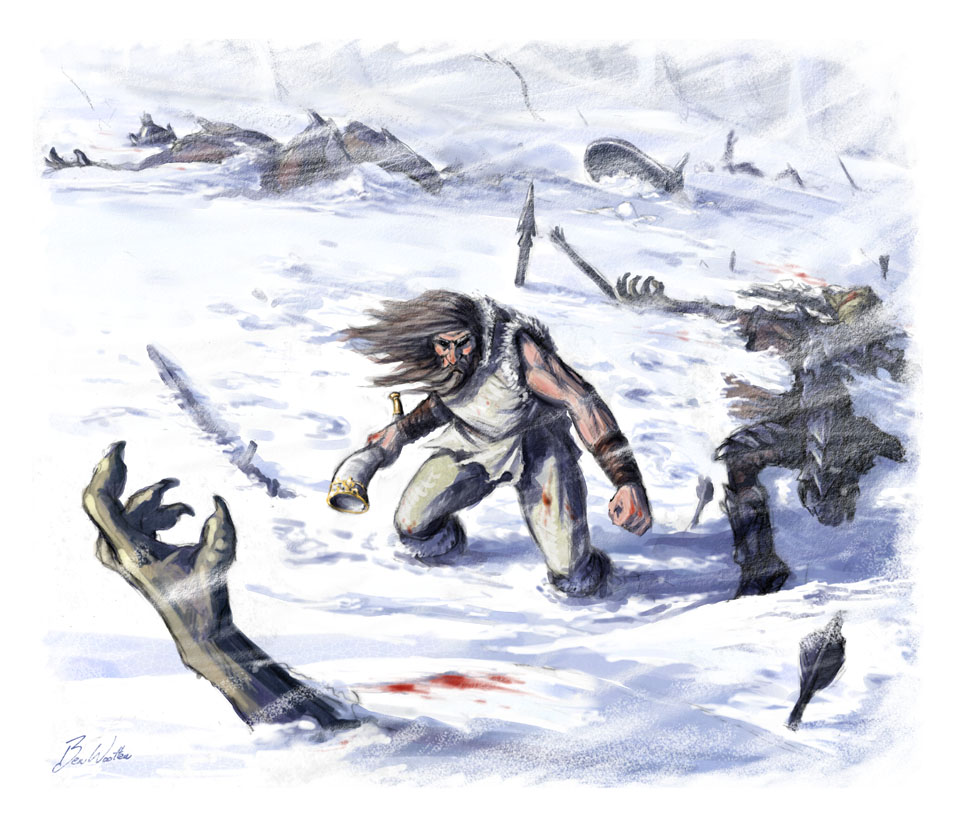
In the year 27558 of the Third Age the armies of Rohan were drawn to the east. Wulf, seeing an opportunity, brought his forces into Rohan from Isengard in the west where he killed the prince and claimed the throne of Rohan. This left King Hammerhand exiled outside his own walls. The situation was compounded by the effects of an unusually long and harsh winter which buried Rohan in snow for the better part of five months. Unable to return and reclaim his throne, Hammerhand and his people took refuge in the Hornburg where they survived the long winter. During this time, Hammerhand would often sneak out under the cover of winter, dressed all in white, blow his horn, and kill the enemy troops with his famed bare hands. On one particular excursion, Hammerhand blew his horn, but when his men came to find him, he was dead, standing upright in the snow.

..

Despite the death of the king, the Rohirrim survived the Long Winter in the refuge of the keep. Thereafter it was known as the Hornburg and the surrounding valley called Helm’s Deep in remembrance of their fallen king. During the Long Winter Hammerhand’s two sons also perished, once the snow had retreated, Helm’s successor, his nephew Frealaf Hildeson, made his way back to Edoras, slayed Wulf, and took back Rohan.

The Battle of the Hornburg and The War of the Ring:

This brings us to the portion of the tale most of you are familiar with, The Battle of the Hornburg, more popularly called the Battle of Helm’s Deep. On the evening of March 3, T.A. 3019 Theoden led the army of Rohan toward the Fords of Isen to fight the forces of Saruman who at this point had been revealed as an ally to Sauron. While on the way, they received word of defeat at the Fords and changed course toward Helm’s Deep. Shortly thereafter Saruman’s forces, comprised of orcs, his specialized Uruk-hai, and Dunlendings arrived and began their attack on the keep.

Though Theoden’s forces, which included members of The Fellowship, Aragorn, Legolas, and Gimli, were vastly outnumbered, the keep’s incredible architecture kept the enemy forces at bay for a time. Saruman however, had no intention of fighting a fair fight, he employed machines of war and explosives that allowed his forces to breach the wall, forcing the Rohirrim and their allies to retreat to the Glittering Caves.

Just then, the horn from which the Hornburg gains its name sounded. Aragorn and Theoden lead a push back into the enemy forces. Just then, Galdalf arrived with reinforcements and when the invaders turned to run, they found their way blocked by Huorns, a sort of semi-sentient trees perhaps related to the Ents, able to move of their own accord but without true sentience. Having seen Gandalf the Dunlendings gave up the fight and were given amnesty in exchange for giving up any future hostilities with Rohan. Thus ended the ages long rivalry between the descendants of The Edain and solidified the importance of Helm’s Deep and the Hornburg in the history of Middle Earth.

Win a Digital Download of ‘The Hobbit: The Battle of the Five Armies’

The release of the final Hobbit movie on DVD and Blu-Ray is almost upon us! We’ve spent a huge chunk of time living in J. R. R. Tolkien’s beloved, fantasy world, and its cinematic vision is about to come to an end. So to celebrate, we want to give you a chance to win “The Hobbit: The Battle of the Five Armies” for free!

All you have to do to enter is send an email with your name and mailing address (no PO Boxes and in the US only, please) to ADAM@BIGSHINYROBOT.COM. If you want an extra entry, just share this contest on Twitter and tag @BIGSHINYROBOT as well as #THEHOBBIT in your tweet!

The contest will run until Friday, March 27, and I will contact the winner shortly thereafter. The prize will be sent out after April third.

Also be sure to check out “The Hobbit: Battle of the Five Armies” app below! In it, you can take a quiz to find out your Middle-Earth weapon of choice as well as learn some really cool fun facts about the making of the movie and the world it takes place in.

Best of luck to all who enter!


Each household is only eligible to win One (1) Digital Download Coupon for The Hobbit: Battle of the Five Armies via blog reviews and giveaways. Only one entrant per mailing address per giveaway. If you have won the same prize on another blog, you will not be eligible to win it again. Winner is subject to eligibility verification.

‘The Hobbit: The Battle of Five Armies’ Review

“The Hobbit: The Battle of Five Armies” (7.5 out of 10) Directed by Peter Jackson; Starring Ian McKellan, Cate Blanchett, Benedict Cumberbatch, Martin Freeman, Richard Armitage, Evangeline Lilly, and others. Adapted by Fran Walsh, Phillipa Boyens, Peter Jackson, and Guillermo Del Toro. Rated PG-13 for extended sequences of intense fantasy action violence, and frightening images. Opens 12/17/14 nationwide.

“The Hobbit: The Battle of Five Armies” is the final installment in the trilogy of films based on the book “The Hobbit,” though it was originally conceived as just two films.

After the monumental success of the “Lord of the Rings” films, I felt able to cut Peter Jackson a lot of slack for his interpretation of the beloved Tolkien masterpiece, “The Hobbit.”

The book is a whimsical children’s story and can be seen as being at odds with the tone of the final film adaptation in Peter Jackson’s life’s work. The first film begins in that world, to be sure, but as the company of Dwarves (along with their wizard and burglar), march toward the lonely mountain, so too does the tone of the story begin to match that of the “Lord of the Rings” films. Some might disagree with this choice, but I think it’s a choice Tolkien would have made. He himself revised his manuscript of “The Hobbit” once “The Lord of the Rings” was released to make it more in line with the newer stories. In this case, Peter Jackson worked in reverse a bit. 

And this is actually, in my view, one of the strengths of the material. Jackson is able to infuse stakes into these films that matter, even though we know that Sauron is going to end up regaining at least some portion of his power and Bilbo’s ring will need to be destroyed. 

This film picks up exactly where last year’s installment left off, with Smaug decimating Lake Town and then we’re treated to the council of wizards and the Lady Galadriel fighting back the Necromancer in order to rescue Gandalf. Both of these sequences were spectacular, but neither felt like a good start to a film. My biggest complaint about this movie is how disjointed and unwhole it feels. It really does feel like it would be impossible to stand on its own without at least “The Hobbit: The Desolation of Smaug” behind it. I would have been more than happy with two four hour movies rather than these three. But that’s a moot point as we enter the third film.

Once we’re into Erebor and we’re given the meat of this film: a battle between five armies. 

Richard Armitage as Thorin Oakenshield is the center of this story, going slowly mad with Dragon Sickness and brings the character more depth than the single dimension we’ve seen him capable of in the prior two installments. Thorin’s bullheadedness is the hinge upon the door to war between the orcs, the humans, the dwarves, and the elves opens. But since you can count, you know there’s a fifth army coming at some point as well. 

The man who steals much of the show from Armitage, though, is Billy Connolly, playing Thorin’s cousin Dain. From the moment he arrives on his armored warboar, the movie is his and you just want to watch him the entire time. In fact, I wouldn’t even mind Peter Jackson figuring out a way to do a movie just about Dain, he’s so compelling and funny and watchable. But I’d also love Jackson to tackle “The Silmarillion.”

The best thing about this installment is that it gives us things we’ve never seen in this universe before and have been wanting to. I’ve always wanted to see an army of mounted dwarves go into battle. I’ve always wanted to see more a street brawl of a fight in Middle Earth rather than the massive formations we’ve been privy to. I’ve always wanted to see Galadriel cut loose and kick some ass. Finally, we’re treated to all of these things in a satisfying way. It feels like once and truly we’re given the close of a saga that’s been almost two decades in the making by now. 

If you’ve been a fan of the previous two “Hobbit” films and Peter Jackson’s take on Middle Earth, you’re going to leave this film satisfied and with more than a few tears in your eye. If you’ve checked out, then there’s probably not a point in seeing it. Overall, I’m rating it a 7.5 out of 10 for the severely clunky opening (despite the fact that the sequences were thrilling) and the beautiful look and feel of the battle sequences. It’s a worthy close to one of my favorite stories.

As an addendum, I’ll admit that I was a little disappointed that the film was not projected at a high frame rate. I’d love to go back and see it in that format. This is a spectacle worthy of it.

REVIEW: The Hobbit: The Desolation of Smaug

THE HOBBIT: THE DESOLATION OF SMAUG (8 out of 10) Co-written and directed by Peter Jackson (based on the novel by J.R.R. Tolkien); starring Martin Freeman, Ian McKellen, Richard Armitage, Evangeline Lilly and the voice of Benedict Cumberbatch; rated PG-13 (extended sequences of intense fantasy action violence, and frightening images); in general release, playing in either 2D, 3D or 3D IMAX; running time: 161 minutes.

When it comes to Peter Jackson, there’s probably one thing on which we can all agree: The dude loves him some J.R.R. Tolkien.

The New Zealand director’s filmic adaptations of Tolkien’s The Lord of the Rings trilogy were either too faithful or they weren’t faithful enough, depending on your own love of/perspective on Tolkien. But no one could say he didn’t put his heart and soul into those productions.

His equally ambitious, three-part cinematic take of Tolkien’s single-volume The Hobbit, have the same share of highlights and problems. For better or worse, the first film in the latter trilogy, An Unexpected Journey, strayed dangerously close to becoming the movie that was skewered by the Kevin Smith-written characters in Clerks 2: There was a lot of walking. So much of it, in fact, that the naysaying complaints about material “padding” – to facilitate three movies – seemed perfectly valid.

Luckily, the second part, The Desolation of Smaug is a considerable improvement on its predecessor. Oh, there are still a lot of scenes featuring characters walking. But they seem briefer and more relevant to the action, and the bits of necessary humor are not so dopey, juvenile and lowbrow (the flatulence and other bodily secretion humor in the first Hobbit was a low point for the Jackson-Tolkien adaptations to date).

Better yet, there seems to be more action this time around. It’s much more thrilling and is, again, pertinent, necessary action. And the character moments just work better in this installment. It’s almost as if Jackson and his talented cast shook off the first film’s dusty, crusty layer and got down to business. (The three films were actually shot consecutively, so it only seems that way.)

The Desolation of Smaug certainly doesn’t waste much time getting back into the action – well, it does after a quick, bread-breaking flashback sequence that features the wizard Gandalf (Ian McKellen) and would-be Dwarf king Thorin Oakenshield (Richard Armitage), and fills newcomers in on what they need to know about the story so far.

Thorin and his party of fellow Dwarves are hoping to make their way to the Lonely Mountain, to reclaim Thorin’s throne and reunite their scattered people. But the path is perilous. While they’ve survived an attack by orcs in the Misty Mountains, those threats (and others) are tracking them through Mirkwood Forest.

Things look even more imposing once they actually get to the Lonely Mountain (if they even do). The fierce dragon Smaug (voiced by Benedict Cumberbatch) lies in wait, protecting his ill-gotten treasure. But Thorin and Co. have one secret weapon: the title character, Bilbo Baggins (Martin Freeman), whom they believe will be able to burgle his way into the Secret Door, into Smaug’s lair. 

Meanwhile, Gandalf, has sensed there are dark forces building, and has left our heroes on their own, so he can confront this additional threat head-on.

As he did with the Rings cast, Jackson has to juggle a huge ensemble. But he does manage to give most of his cast their time and even shines a spotlight on a couple of breakout (or even returning) characters. Evangeline Lilly (TV’s Lost) kicks a surprising amount of butt in her supporting performance as an elf warrior, while Orlando Bloom seems to be enjoying himself more than usual, reprising his role as Legolas.

(Lilly’s Tauriel just might be the female cosplay costume for next year, while males can try their hand at Legolas… or the less-fit ones can settle for being Freeman’s slightly less heroic Bilbo.)

Both Lilly and Bloom are front-and-center for the film’s best action sequence, one in which they take on an orc army, chasing them across rocks, rivers and a forest, as well as over the tops of some Dwarf heads. Though even this pales in comparison to the highly anticipated, very tense and intense Bilbo-Smaug confrontation. (Cumberbatch appears to be echoing the late George Sanders; his Smaug has the same intonation and menace of Sanders’ Shere Khan, from Disney’s The Jungle Book.)

And yes, the film does leave off on a cliffhanger note, to make us anticipate next year’s third in the trilogy (There and Back Again) even more. But it feels less like a cheat than a similar scenes did in the recent Hunger Games sequel, and more like the still-delightfully soul-crushing one in Star Wars: The Empire Strikes Back.

Jeff Michael Vice, aka Jerk-bot, can be heard reviewing films, television programs, comics, books, music and other things as part of The Geek Show Podcast (www.thegeekshowpodcast.com), as well as be seen reviewing films as part of Xfinity’s Big Movie Mouth-Off (www.facebook.com/BigMovieMouthOff).